In this guide
The Short Answer
Standard pallet rack dimensions in North America are a 42 in deep frame under a 48 × 40 in pallet, with 96 in beams for two pallets per level and frames from 8 to 20 ft tall. In Europe the equivalent is an 1100 mm frame under a 1200 × 800 mm Euro pallet and a 2700 mm beam for three, with about 75 mm between loads.
We build RackCity AI, a layout tool that draws racking to these dimensions. Every figure below links to its manufacturer or standard. This is a reference for laying out and quoting, not engineering.
Upright Frame Depths and Heights
A frame's depth is measured across the rack, front post to back post, and it is chosen from the pallet. Lyon's pallet rack sell sheet is a typical North American stock list: frames 36, 42 and 48 in deep, each 96, 120, 144, 192 or 240 in tall, with beams adjustable on 2 in vertical centers. It calls the 42 in frame the most popular, because the most common pallet is 48 in deep and rests on both beams without decking.
| Dimension | Imperial | Metric | Source |
|---|---|---|---|
| Frame depth, stock | 36, 42, 48 in | 914, 1067, 1219 mm (converted) | Lyon sell sheet |
| Frame height, stock | 96 to 240 in (8 to 20 ft) | 2.44 to 6.10 m (converted) | Lyon sell sheet |
| Rack height, built | 4 to 40 ft, higher in automated systems | A few metres to over 40 m in automated warehouses | Interlake Mecalux, Mecalux |
| Beam adjustment pitch | Posts slotted every 2 in | Uprights slotted every 50 mm | Interlake Mecalux, Mecalux |
Height has a limit set by depth. The Rack Manufacturers Institute measures a single row's height-to-depth ratio from the floor to the top of the top beam, over the frame depth outside to outside. Up to 6 to 1, normal anchoring is usually adequate; past 6 to 1 the anchors and base plates should be designed to resist overturning; past 8 to 1 it recommends overhead ties. For a 42 in frame, 6 to 1 is a top beam at 21 ft; for an 1100 mm frame, 6.6 m. The FAQ writes these limits for single rows of rack.
Beam Lengths and Profiles
Beams come in lengths that fit a whole number of pallets plus the gaps, one pair per level. Three US manufacturers publish these ranges:
| Manufacturer | Lengths | Beam face (height) |
|---|---|---|
| Interlake Mecalux | 48 to 168 in (1219 to 4267 mm) | 2.75 to 6.54 in (70 to 166 mm) |
| UNARCO | 36 to 192 in (914 to 4877 mm) | 2.5 to 6 in (64 to 152 mm) |
| Steel King SK2000 | 48 to 192 in (1219 to 4877 mm) | 3.19 to 6.06 in (81 to 154 mm) |
Steel King's beam chart also says how many pallets each length is meant for: one on 48 to 78 in beams, two on 84 to 126 in, three on 132 to 174 in and four on 180 to 192 in. A taller face carries more at a given length, and takes more height from every level. Interlake Mecalux rates its beams at the lesser of bending strength and a deflection of the span divided by 180.
Step beams. The usual roll-formed teardrop beam has a ledge along its top inside edge. UNARCO calls the 1-5/8 in step the industry standard, sized for standard wire decking or lumber, on a beam 2-3/4 in deep overall with a 1 in ledge. Lyon's beams have the same integrated 1-5/8 in step and are completely enclosed, a closed box section with the step formed into it.
Structural beams. Hot-rolled C-channel beams are the bolted alternative. Interlake Mecalux describes them as measured by weight rather than gauge and adjustable on 2 in centers.
Standard Pallet Sizes
The rack is sized around the pallet:
| Pallet | Metric | Imperial | Where |
|---|---|---|---|
| GMA (ISO 3) | 1219 × 1016 mm | 48 × 40 in | The standard unit load across the US, Canada and parts of Latin America (Interlake Mecalux) |
| EUR / EPAL Euro pallet (ISO 1) | 1200 × 800 mm, 144 mm high | 47.2 × 31.5 in | Europe (EPAL) |
| Industrial (ISO 2, EUR 2) | 1200 × 1000 mm | 47.2 × 39.4 in | GS1 also names it the EUR 2 |
| ISO 4 | 1067 × 1067 mm | 42 × 42 in | Mainly the Americas |
| T11 | 1100 × 1100 mm | 43.3 × 43.3 in | Mainly Asia Pacific |
| ISO 6 | 1140 × 1140 mm | 44.9 × 44.9 in | Mainly Europe |
The six rows are the ISO 6780 sizes as GS1's pallet code list labels them, with the regions it gives; ISO's own pages could not be read for this guide. Imperial figures for the metric pallets are converted. Two practical notes. The 1200 × 1000 mm pallet has about the same footprint as a GMA pallet. And a Euro pallet is normally racked with its 800 mm face to the aisle: SEMA points out that with the 1200 mm face out, no bottom board spans the beams.
How the Pallet Sets the Frame and the Beam
Frame depth. A pallet should overhang the front and back beams by the same amount, so it sits on both. In North America that is about 3 in a side: Interlake Mecalux puts a 48 in deep GMA pallet on a 42 in frame. SEMA, the UK's Storage Equipment Manufacturers' Association, recommends 50 mm of overhang front and back, which puts a 1000 mm deep pallet on a 900 mm frame, and in another answer it names an 1100 mm frame for a pallet supported in its 1200 mm direction.
Beam length. Add the pallet widths and the gaps. Interlake Mecalux's pallet rack selection guide (a PDF hosted by a distributor) allows 3 to 6 in between loads and pairs beams with pallets like this:
| Beam | Pallets per level | Pallet face to the aisle |
|---|---|---|
| 48 in (1219 mm) | 1 | 40 in |
| 96 in (2438 mm) | 2 | 40 in |
| 108 in (2743 mm) | 2 | 48 in |
| 120 in (3048 mm) | 3 | 36 in |
| 144 in (3658 mm) | 3 | 40 in |
The metric module works the same way with SEMA's 75 mm gaps. Two 1200 mm pallets need 2625 mm (2400 mm of pallet and three gaps), and three 800 mm Euro pallets need exactly 2700 mm, which also takes two 1200 mm pallets with a little room for overhang. Mecalux's standard Euro-pallet beams are 1825, 2700 and 3600 mm, which work out to two, three and four Euro pallets on the same gaps; for GMA pallets it lists 2225 and 3300 mm.
Level pitch. The vertical spacing from one beam to the next is the load height, the clearance above it and the beam face. Interlake Mecalux's guide sizes an upright as the load height plus 4 to 6 in of vertical loading clearance plus the beam height, times the number of levels.
Clearances: Between Loads, Above Loads and in the Flue
| Clearance | US guide | Europe (SEMA) |
|---|---|---|
| Between adjacent loads | 3 to 6 in (76 to 152 mm), Interlake Mecalux | 75 mm (3 in), rising to 100 mm higher up |
| Load to upright | Not stated separately in the guide | 75 mm (3 in), rising to 100 mm higher up |
| Top of load to the beam above | 4 to 6 in (102 to 152 mm), Interlake Mecalux | 75 mm; 100 mm at 6 m; 125 mm at 9 m and above |
| Overhang, front and back | About 3 in (76 mm) a side, from the 42 in frame under a 48 in pallet | 50 mm (2 in) a side |
| Back-to-back (longitudinal flue) | 6 in (152 mm) between loads most common, Steel King | 200 mm between frames, 100 mm between pallets |
Height raises the numbers. SEMA's columns give 75 mm beside and above each load, rising to 100 mm beside it at 9 m, or above a 6 m beam when the driver works from the floor without automatic height selection or a mast camera, and to 100 mm then 125 mm above it at 6 m and 9 m. A man-up truck or one with a camera on the mast keeps 75 mm throughout.
Flue spaces. Flues are clear vertical gaps from floor to ceiling, which Steel King says speed fire detection and suppression. It defines transverse flues as the spaces between pallets, and between pallets and uprights, facing the aisle, and the longitudinal flue as the space between back-to-back rows, where 6 in between loads is the most common requirement. The NFPA sets the minimums, and the local code may differ. Lyon's row spacer is 8 in. In Europe, SEMA recommends 200 mm between back-to-back frames, which leaves 100 mm between pallets after 50 mm of overhang each.
The European standards. EN 15620:2021 "specifies tolerances, deformations and clearances" for pallet racking, with sections on clearances in a bay and in the depth. SEMA's columns predate that edition, so check a project against the standard. EN 15635 covers application and maintenance; Mecalux cites it for annual rack inspection.
How RackCity AI Uses These Dimensions
In RackCity AI, frame depth, beam length, levels, upright height and pallet height are set per zone, and every count and drawing follows them. A 42 in frame is drawn and counted as 42 in. Design in feet and inches or metres and millimetres, with US or Euro pallet sizes, and change a bay that differs with Bay Controls, which override its beam count or pallet height for a column, a low door or a different pallet at one end of a row.
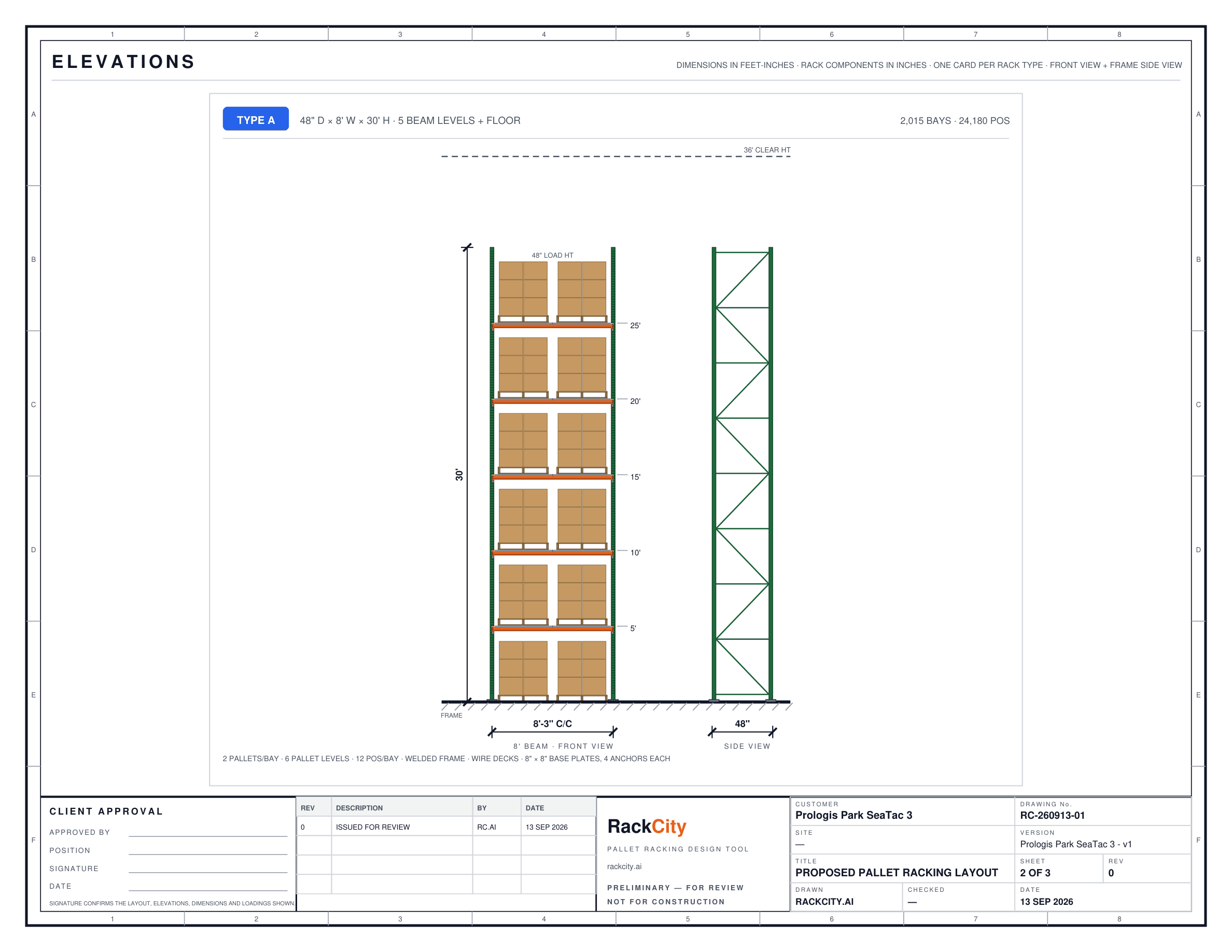
The elevation drawing shows them: one per rack type, with the upright punching, beam levels and endplates, pallet loads and height dimensions, plus the frame's side view. It is free to start; the Layout PDF that carries the elevations is a paid-plan export.
RackCity AI does no structural calculation: no beam or frame capacity, no deflection or overturning check, and nothing it exports is stamped. Capacities come from the manufacturer's charts, the design from a qualified engineer.
Frequently Asked Questions
What size pallet rack do I need for a 48 x 40 pallet?
A 42 in deep frame, so the 48 in pallet overhangs 3 in front and back. With the 40 in face to the aisle, a 96 in beam holds two pallets and a 144 in beam holds three; with the 48 in face to the aisle, Interlake Mecalux pairs two pallets with a 108 in beam.
How much clearance do you need above a pallet in a rack?
Interlake Mecalux's selection guide allows 4 to 6 in between the top of the load and the beam above. SEMA, the UK manufacturers' association, gives 75 mm, rising to 100 mm at a 6 m beam height and 125 mm at 9 m and above. SEMA keeps 75 mm throughout for a man-up truck or one with a camera on the mast.
What beam length fits Euro pallets?
Mecalux lists 1825, 2700 and 3600 mm as its standard beams for Euro pallets. With the 800 mm face to the aisle and SEMA's 75 mm gaps, 1825 mm holds two and 2700 mm holds three, which SEMA calls a common application; 3600 mm leaves room for four.
How deep should a pallet rack frame be?
Shallower than the pallet, so the pallet overhangs both beams. The US habit is about 6 in less than the pallet depth, a 42 in frame for a 48 in pallet. SEMA recommends 50 mm of overhang front and back, which puts a 1200 mm pallet on an 1100 mm frame and a 1000 mm pallet on a 900 mm frame.
Does RackCity AI check rack capacity?
No. RackCity AI lays out and draws racking to the dimensions you set and counts the pallet positions, but it does no structural calculation, gives no capacity rating and stamps nothing. Beam and frame capacities come from the manufacturer's charts, and the design from a qualified engineer.
Manufacturers: Interlake Mecalux's pallet racking page, beam load capacities, beam types, GMA pallet and pallet rack selection guide; Mecalux pallet racking; UNARCO beam sizes; Steel King's SK2000 capacity chart (May 2025) and flue space; Lyon pallet rack sell sheet. Rack standard: the Rack Manufacturers Institute's FAQ on ANSI MH16.1. Pallets: EPAL and GS1 Sweden's platform type codes for ISO 6780. Europe: SEMA's technical answers in Warehouse News (May 2013, December 2013, December 2014, October 2016) and the EVS catalog entries for EN 15620:2021 and EN 15635. Metric and imperial conversions marked "converted" are ours. A manufacturer's figures describe its own products; use the charts for the steel you are buying.