In this guide
We build RackCity AI, and until this summer it was an imperial tool that could show you metres. Half of the people using it work in millimetres — the UK, Germany, Australia, the Netherlands, France — and a converted catalog is not a metric catalog: a "1,067 mm" frame is a 42 in frame wearing a disguise, and no European supplier sells one. So v1.3 made metric a mode the whole app runs in, with an EU/ISO catalog behind every dropdown. This guide is the racking arithmetic in those units.
The Pallets
Everything in a metric rack layout follows from the pallet, and there are more of them than in North America, where the 48 × 40 in GMA pallet is nearly universal:
| Pallet | Face × depth (mm) | Where | Three-pallet beam |
|---|---|---|---|
| Euro (EUR/EPAL 1) | 800 × 1,200 | Europe, the default | 2,700 mm |
| Industrial (EUR 2 / UK standard) | 1,000 × 1,200 | UK, chemicals, FMCG | 3,300 mm |
| Industrial, long side facing | 1,200 × 1,000 | Deep-stored industrial | 3,900 mm (or 2,700 for two) |
| Square | 1,100 × 1,100 / 1,165 × 1,165 | Asia / Australia | 3,600 mm |
| Chemical / drum | 1,200 × 1,200 | Drums, IBCs | 3,900 mm |
"Face" is the side that looks at the aisle. A Euro pallet is normally stored short side to the aisle (800 mm face, 1,200 mm deep), which is why the frame it sits on is 1,100 mm deep: the pallet overhangs the beams by 50 mm front and back, on purpose, so the forks find the beam edge.
The Beams: Three Pallets and 100 mm
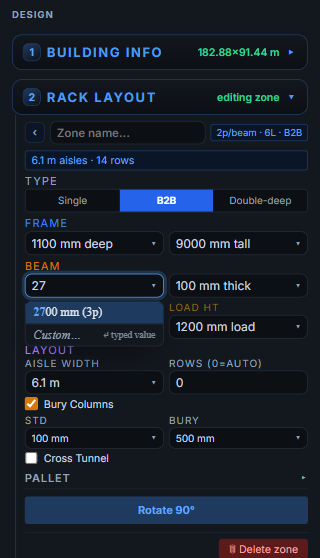
RackCity AI's metric pallet-count model allocates 50 mm on each side of each pallet. Three 800 mm pallet faces therefore use 3 × (800 + 2 × 50) = 2,700 mm of beam length: 100 mm between adjacent loads and 50 mm at either end. The same model gives 3,300 mm for three 1,000 mm faces and 3,900 mm for three 1,200 mm faces. The catalog labels the 2,700 mm option 2700 mm (3p). These are the software's planning assumptions; confirm the required clearances and component sizes with the rack supplier for the actual installation.
The stock beam lengths in the catalog, and what they carry:
- 1,350 mm — one 1,200 mm face, or the short bay at the end of a run
- 1,800 mm — two Euro pallets
- 2,250 mm — two industrial pallets
- 2,700 mm — three Euro, or two 1,200 mm faces
- 2,900 / 3,300 mm — three industrial (with room for wider loads at 3,300)
- 3,600 / 3,900 mm — three square or 1,200 mm pallets
Beam section (the box beam's depth, 80 to 160 mm in the catalog) is the capacity: a pair of 100 mm beams carries around 2,000 kg across 2,700 mm; three loaded Euro pallets at 1,000 kg each want a 140 or 160 mm beam. The supplier's load table settles it; the layout tool only needs the number for the elevation and the bill of materials.
Frames: Depth and Height
Depth follows the pallet: 1,100 mm for Euro pallets stored short side out, 900 mm for the same pallet long side out, 1,000 or 1,200 mm for industrial and square pallets. The catalog offers 900, 1,000, 1,100 and 1,200; a stored value that isn't one of those is shown as its own row rather than rounded to the nearest.
Height runs from 2,500 mm in 500 mm steps to 8,000, then 9,000 to 12,000 mm. The frame is chosen from the clear height and the beam levels: each level needs the load height plus about 100 mm lift-off clearance plus the beam section, and the top load needs whatever the sprinkler design asks for above it. A 1,500 mm loaded Euro pallet on a 100 mm beam takes about 1,700 mm a level; under 8 m clear that is four beam levels over a floor position on a 7,000 mm frame, with room to spare for the sprinklers.
Between the backs of a back-to-back pair, the row spacers set a flue of 200 to 300 mm (the catalog runs 100 to 600); the sprinkler designer will tell you which, and the building's columns usually decide where the pairs go so that the columns land in that gap.
Aisles in Metres
The aisle is set by the truck, measured between rack faces, and it is the largest single lever on the count after height:
| Truck | Aisle | Lift height |
|---|---|---|
| Counterbalance (sit-down) | 3.4–4.3 m | to ~6 m |
| Stand-up rider / wide aisle | 3.0–4.0 m | to ~7 m |
| Reach truck | 2.4–3.4 m | to 9–12 m |
| VNA turret / man-up | 1.5–2.1 m | to 14 m+ |
Start from the truck's right-angle stacking aisle (Ast on the data sheet, for the pallet you run) and add 150 to 300 mm. The catalog offers aisles from 1.5 to 5.0 m in 0.1 m steps and RackCity AI draws every aisle at exactly the width you type; a depth that doesn't divide evenly leaves an open band drawn as such. The aisle-width guide goes through the trucks and the arithmetic in both unit systems.
A Worked Example: 60 × 40 m
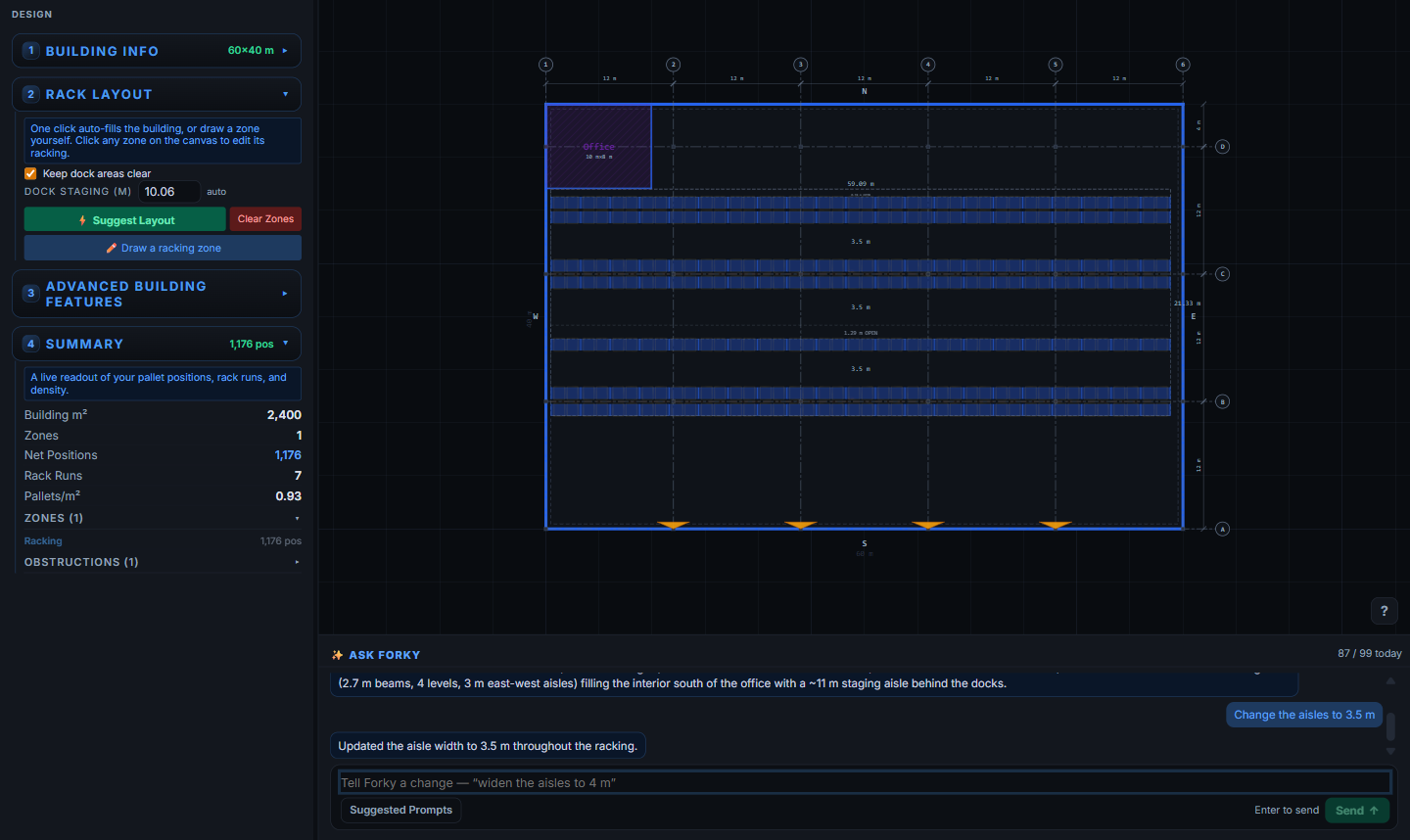
A 2,400 m² unit, 60 × 40 m with 8 m clear, four dock doors on one 40 m wall, Euro pallets loaded to 1,500 mm, reach trucks. The spec: 1,100 mm frames, 7,000 mm high, 2,700 mm beams, floor plus three beam levels, 3.0 m aisles, 250 mm flue.
Across the 40 m depth, each back-to-back module is two 1,100 mm frames, the 250 mm flue and a 3.0 m aisle: 5.45 m. Keep 4 m clear along the dock wall and 36 m remain: six pairs plus a single row against the back wall, thirteen rows. Along the 60 m length, a bay is 2,700 mm of beam plus the post, about 2.8 m: 21 bays a row. Positions: 13 rows × 21 bays × 3 pallets × 4 levels = 3,276 before the columns and the office; about 3,100 after them, or 0.77 m² per position.
Two things to notice against the imperial version of the same building. Three pallets a beam instead of two, and a 3.0 m aisle instead of 12 ft (3.66 m), put this floor at 0.77 m² a position where a GMA layout on the same slab would sit near 1.1–1.3 m² (12–14 sq ft). And the reach truck's lift height, not the building, is what stops it at four levels: at 9 m clear with a 10.5 m truck the same floor takes a fifth level and 3,900 positions.
Doing It in RackCity AI
- Pick Metric from the units dropdown on the toolbar (a first visit from a metric country starts there). Nothing reloads; every field, label, catalog and export follows, and nothing you've drawn moves.
- Enter the building in metres, or describe it to Forky AI: "60 m by 40 m, 8 m clear, 2700 mm beams, 4 levels, 3 m aisles, four docks on the south wall." The reply comes back in metres and the canvas reads 60 × 40 m and 3 m aisles, not 59.99 or 3.05.
- Pick the pallet — Euro, industrial, square, or your own dimensions — and the frame depth and clearance follow.
- Pick the beam by typing into the dropdown: 27 narrows to 2,700 mm, 3p shows every three-pallet beam. A length that isn't in the catalog — a supplier's 2,750 — is accepted as typed.
- Set the aisle in metres for the truck and read the count on the header.
- Export. The Layout PDF, the bill of materials and the Pricing Summary carry a Units: Metric (m · mm · kg) stamp, so the supplier in Rotterdam and the client in Chicago each read the same project in their own units without anyone converting.
The design underneath is the same whichever units are showing, which is the part that matters for a project that crosses a border: switch to Imperial and back and every value returns to exactly what it was.
The language, the currency on the quote and the number and date formats follow the same way, from your region until you pick them in Preferences. The languages, units and currencies page lists every one RackCity AI works in.
Standards
The geometry above is what a layout tool gives you. The steel is designed to a standard by the supplier's engineer, and the names come up in every European tender: EN 15512 for structural design of adjustable pallet racking, EN 15620 for tolerances, deformations and clearances (where the 100 mm figure and its taller-rack variants live, alongside DGUV 108-007 in Germany and the FEM 10.2.02 guidance), EN 15629 for specifying the system, and EN 15635 for use, inspection and maintenance once it's up. The UK adds the SEMA codes and the annual SARI inspection. None of that changes the layout; all of it changes what the supplier quotes you for it.
Frequently Asked Questions
What are standard pallet racking dimensions in mm?
For Euro pallets (800 × 1,200 mm): frames 1,100 mm deep, beams 2,700 mm long holding three pallets a level, frame heights from 2,500 mm in 500 mm steps to 8,000 and on to 12,000 mm, beam sections 80–160 mm deep by load. For industrial 1,000 × 1,200 pallets the beam is 3,300 mm; for 1,200 × 1,200, 3,900 mm. RackCity AI's count allows 100 mm between loads and 50 mm at each end; confirm installation clearances with the supplier.
How many Euro pallets fit on a 2,700 mm beam?
Three in RackCity AI's metric planning model, with the 800 mm side facing the aisle: 3 × (800 + 2 × 50) = 2,700 mm. This allocates 100 mm between adjacent loads and 50 mm at either end. Confirm the required clearances with the rack supplier; the software's count is not structural approval.
How wide should a forklift aisle be in metres?
Between rack faces: 3.4–4.3 m for a counterbalance truck, 3.0–4.0 m for a stand-up rider, 2.4–3.4 m for a reach truck, 1.5–2.1 m for a very-narrow-aisle turret truck on guidance. Start from the truck's right-angle stacking aisle (Ast) on its data sheet and add 150–300 mm.
Does RackCity AI work in metric?
Yes, natively since v1.3: pick Metric from the units dropdown and every field, canvas label, catalog and export is in metres, millimetres and kilograms, with an EU/ISO rack catalog and Euro and industrial pallet sizes. A metric prompt to Forky AI comes back in metric, exactly. The design underneath is the same whichever units are shown, so a project can be read in either.
What standards apply to pallet racking in Europe and the UK?
EN 15512 (structural design), EN 15620 (tolerances and clearances), EN 15629 (specification) and EN 15635 (use, inspection and maintenance), with SEMA guidance in the UK and DGUV guidance in Germany. A layout tool gives you the geometry and the count; the rack supplier's engineer designs the steel to the standard.