In this guide
Every rack quote is compared on one figure: dollars per pallet position, the whole job divided by the number of pallets it stores. Dealers quote on it, buyers compare on it, and it is the number that lets a small dense layout and a big loose one sit on the same page. We build RackCity AI, a tool that counts the positions and builds the bill of materials the figure is made from, so we see a lot of these quotes. The ranges below are what they look like in 2026; the worked example shows how one is built.
The Numbers, by Configuration
Installed, materials plus labour, US, new steel, per pallet position:
| Configuration | Per position, installed | Per sq ft of building | What moves it |
|---|---|---|---|
| Selective, back-to-back, 4–5 levels | $80–$120 | $5–$9 | Beam capacity, decking, local labour |
| Selective, 6+ levels (heavy frames) | $110–$160 | $8–$12 | Post gauge, bracing, lift equipment on site |
| Double-deep | $130–$180 | $10–$14 | Deeper frames, pantograph reach trucks |
| Very narrow aisle (VNA) | $150–$220 | $14–$20 | Floor guidance, slab flatness, tall frames |
| Used selective steel | $50–$100 | $3–$7 | Condition, matching profiles, no capacity data |
Two things to read off the table before going further. The per-square-foot column rises as the per-position column rises, because the dense configurations put more pallets on the same slab — you pay more for the floor and less for each pallet on it. And the ranges are wide because the biggest inputs, labour and freight, are local: a job in Los Angeles and the same job in Kansas City can differ by 25 % on identical steel.
What's Inside a Cost per Position
Take a typical selective position at $115 installed. Roughly:
- Upright frames — $25–$35. Two posts, bracing, footplates, in a height and depth. The tallest single line on most quotes because a 20 ft frame is a lot of steel and only serves the bays either side of it.
- Beams — $25–$35. A pair per level per bay. Capacity is what you pay for: a beam rated for two 2,500 lb pallets costs more than one for two 1,500 lb pallets, and the rating has to match the heaviest thing you'll ever put on it.
- Decking — $15–$25. Wire decks on every level, or cross-bars if the pallets are consistent. Often the line a budget quote quietly leaves out; the fire marshal and the insurer will not.
- Row spacers, anchors, guards — $3–$8. Small individually, never zero.
- Installation — $15–$30. A crew of three or four sets 600–800 positions in two to five days: unloading, standing frames, levelling, anchoring into the slab, hanging beams and decks. Tall frames, tight aisles and working around stock all push this up.
- Freight — $5–$10. Steel is heavy and frames are long; a 25,000 sq ft job is two or three flatbeds from the mill or the yard.
- Engineering and permit — $3–$8. The stamped drawings most jurisdictions require above 8 ft, the seismic calculation where it applies, and the permit fee. Mostly fixed per job, so it is a bigger share of a small one.
Materials are 60–70 % of the total, labour 15–25 %, the rest freight and paper. That split is worth knowing when a quote arrives as a single number.
A Worked Quote: 25,000 sq ft, 1,800 Positions
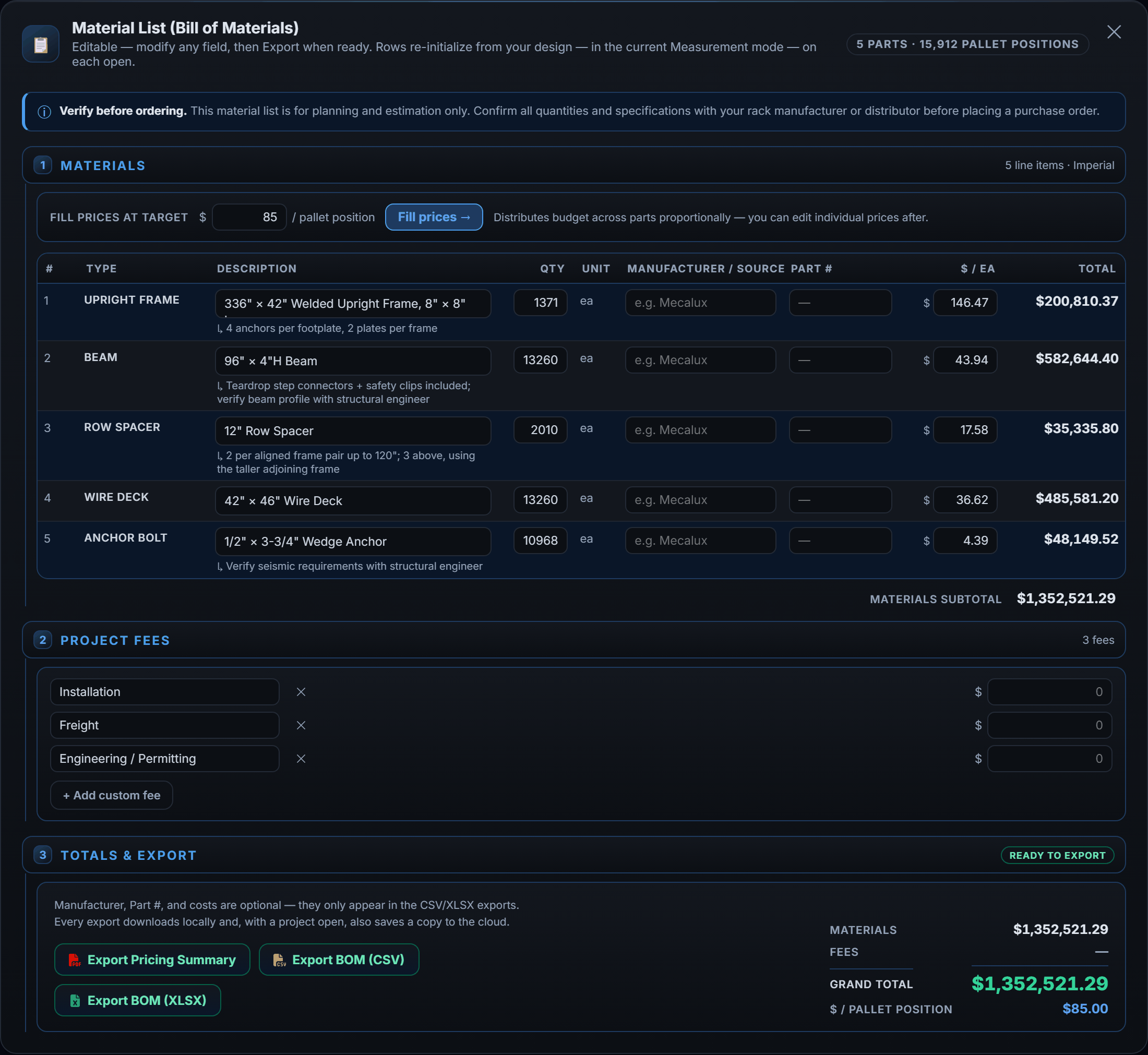
The building from the 3PL worked example: 250 × 100 ft, 28 ft clear, nine rows of back-to-back selective racking on 96 in beams and 42 in frames, floor plus three beam levels, about 1,800 pallet positions once the office, the tunnels and the columns are taken out. The bill of materials from that layout, priced at 2026 mid-market rates for new steel:
| Line | Quantity | Unit | Line total |
|---|---|---|---|
| Upright frames, 42 × 240 in | 261 | $180 | $46,980 |
| Beams, 96 in, 2 per level per bay | 1,512 | $45 | $68,040 |
| Wire decks, 42 × 46 in | 1,512 | $30 | $45,360 |
| Row spacers | 116 | $8 | $928 |
| Anchor bolts | 1,044 | $3 | $3,132 |
| Materials | $164,440 | ||
| Installation | 1,800 positions | $20 | $36,000 |
| Freight | 3 loads | $7,500 | |
| Engineering and permit | 1 job | $6,000 | |
| Total | $213,940 | ||
| Per pallet position | 1,800 | $119 | |
| Per square foot | 25,000 | $8.56 |
$119 a position, $8.56 a square foot, materials at 77 % of the total. Replace the wire decks with cross-bars and the figure drops to about $105; use sound used frames and beams from a yard and it can reach $85; go to five beam levels on 28 ft frames (the building's clear height allows it) and the count rises to about 2,250 while the total rises less, and the position cost falls to around $108. Every one of those is a change to the layout first and a change to the price second, which is the point of building the quote from a drawing.
Why per Square Foot Misleads
Per square foot is the number a landlord or a broker reaches for, because rent is quoted that way. It says almost nothing about racking. The same 100,000 sq ft building racked at four levels on 12 ft aisles costs perhaps $600,000 to fit out; at six levels on 9 ft aisles, $950,000. The second building is 58 % more per square foot and about 15 % less per pallet, because it holds nearly twice the pallets. A buyer comparing the two on square footage picks the wrong one. Compare on positions, and use square footage only to check that the layout is in the normal 8–16 sq ft per position band for the configuration.
The Five Levers
- Height. More beam levels on the same slab is the cheapest capacity there is. A sixth level adds one beam pair and a deck per bay to a frame you were buying anyway; the count goes up 20 %, the total goes up perhaps 8 %. The limit is the clear height, the sprinklers and the truck's lift.
- Beam length and capacity. Three-pallet beams (12 ft, or 3,300–3,900 mm in metric) mean fewer frames per position, but a heavier beam. Whether it saves money depends on the pallet weight; run both in the layout.
- Decking. Wire decks are $15–$25 a position and the most common line to under-specify. Cross-bars cost about half; no decking at all is only acceptable for consistent, well-built pallets, and your insurer may have a view.
- Aisle width and truck. A narrower aisle buys rows, not cheaper steel — the per-position cost barely moves, the per-square-foot cost rises, and the truck is a separate line in a different budget. The aisle-width guide has the arithmetic.
- New or used. The one lever that moves the material line by a third. See below.
Used Racking
Used selective racking sells for 40–60 % of new, which takes $30–$50 off an installed position. That is real money on 1,800 positions. The things that eat into it: matching — a teardrop frame from one maker and a beam from another may or may not lock together, and a yard's inventory rarely comes in one profile; condition — every post and beam needs a look for bends, rust and previous impact repairs, and a damaged upright is a liability, not a bargain; and paperwork — the engineer stamping your permit drawings needs load data the original manufacturer published, and for old or unbranded steel it may not exist, which means load testing or a conservative rating that costs positions. Used is a good answer for a low, uniform, well-documented job. It is a poor answer for tall racking, seismic zones or anything that will be re-permitted.
Getting Your Own Number
A range is for screening. The number for a real building comes from a real layout, and it comes in three steps:
- Draw the racking on the building — the actual footprint, clear height, columns and docks — and read the pallet-position count. In RackCity AI that is typing the dimensions or uploading the flyer, setting the rack spec, and reading the header.
- Open the bill of materials. The frames by height, the beams by length and level, the decks, spacers and anchors are counted from the layout. Put a supplier's unit prices on each line, or start with a target per position — the fill begins at $85 — and refine.
- Add the fee lines — installation, freight, engineering and permit — and read the total and the cost per position on the Pricing Summary. Then change one lever at a time and watch it move.
Walk into the supplier's quote with that in hand and the conversation is about their unit prices, not about whether the number is in the right neighbourhood.
Frequently Asked Questions
How much does pallet racking cost per pallet position?
Installed selective pallet racking runs about $80–$160 per pallet position in the US in 2026: roughly $60–$100 of that is steel and decking, $15–$30 installation, and the rest freight, engineering and permits. Double-deep runs $130–$180, very-narrow-aisle $150–$220. Used steel can take $30–$50 off the material line.
How much does pallet racking cost per square foot?
About $5–$12 per square foot of building for installed selective racking — but the figure depends entirely on how densely the floor is racked. A tall building with tight aisles spends more per square foot and less per pallet, which is why the trade quotes per pallet position instead.
How much does it cost to install pallet racking?
Installation alone is typically $15–$30 per pallet position for selective racking — a crew of three or four sets 600–800 positions in two to five days — plus a mobilisation charge on small jobs. Tall frames, double-deep and anything needing floor guidance cost more per position; a re-rack that has to work around stock already on the floor costs the most.
Is used pallet racking cheaper?
Usually 40–60 % of new on the steel, so $30–$50 less per position installed. The catches: matching the frame profile and beam connector so the parts interchange, inspecting every beam and post for damage, and the lack of manufacturer capacity data for the engineer — which can cost you at permit time what you saved on the steel.
Does taller racking cost more per pallet position?
Slightly more per position for the steel — heavier posts and bracing — and noticeably less per square foot, because the same slab holds more pallets. Going from four beam levels to six adds about 50 % to the count for perhaps 10–15 % more per position, which is why height is the first lever to pull on a cost-per-position quote.