In this guide
If you've just leased a building, or you're about to, someone will ask how many pallets it holds. A racking contractor will answer that question for you, but only after a site visit, and only with a number that suits the system they'd like to sell. This guide gives you the number first. We build RackCity AI, the layout tool used in the examples below, so read the product mentions with that in mind; the arithmetic is the same whether you use it or a pencil.
What Is Pallet Racking?
Pallet racking is steel shelving sized for forklifts. Every distribution center, big-box back room and cold store runs on it: long rows of upright frames with beams between them, loaded from an aisle by a truck. There are three parts you need to know by name, because every quote is written in them.
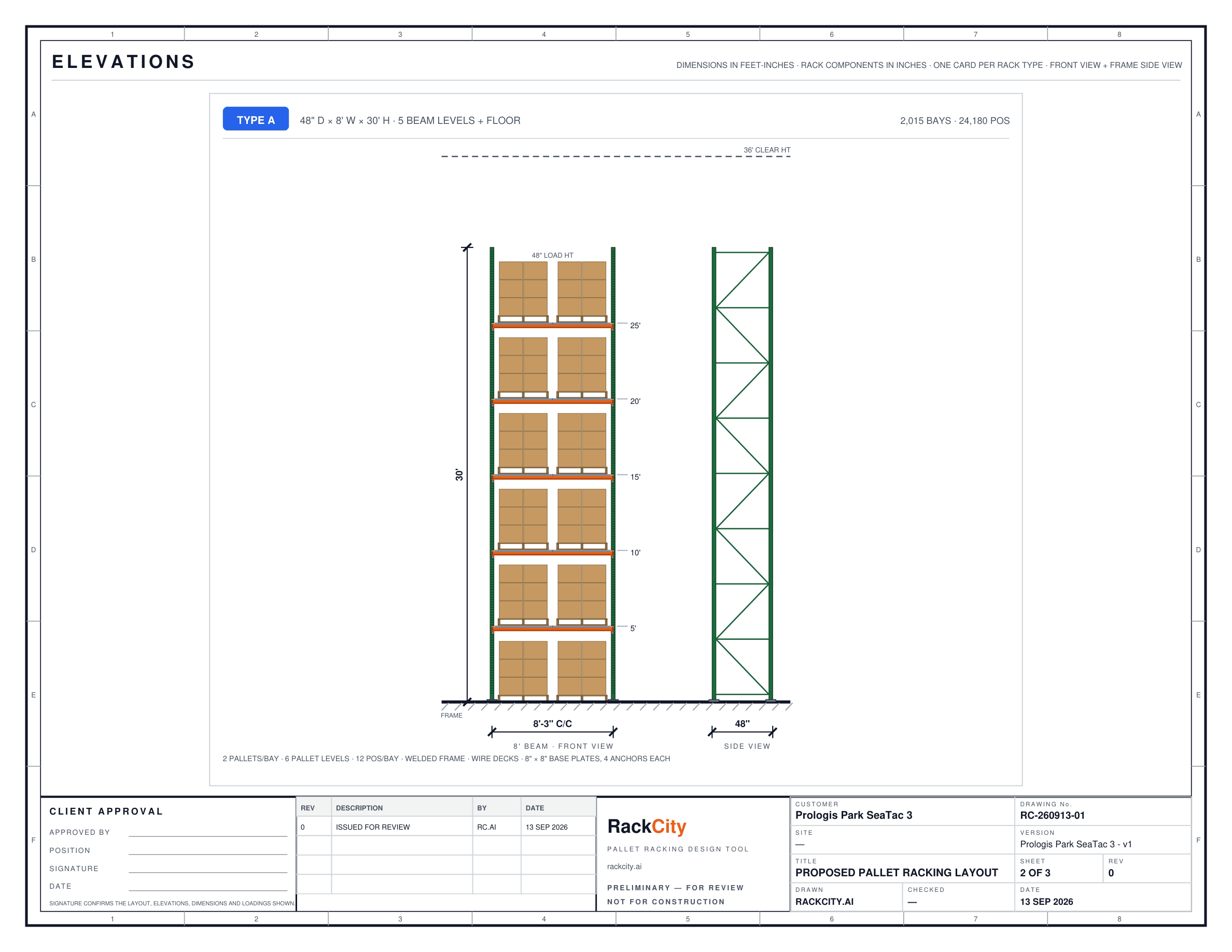
- Upright frames — the vertical columns, anchored to the slab. Heights run from 8 ft to over 40 ft; what you can use is set by the building's clear height and how high your forklift can lift.
- Beams — the horizontal bars that hook into the uprights and carry the pallets. They come in pairs (front and back), and the length of the pair decides how many pallets sit side by side on a level.
- Bays — one opening between two uprights. An 8 ft beam bay holds two 48 × 40 in pallets per level with room to spare; a 12 ft bay holds three. In Europe a 2,700 mm beam holds three 800 mm-wide Euro pallets.
A pallet position is one pallet's slot. It is the unit everything else is priced and planned in: positions = bays × beam levels × pallets per bay. Floor-level positions (pallets sitting on the slab under the first beam) count too.
The Quick Estimate
For ordinary back-to-back selective racking, plan on one pallet position per 8–16 sq ft of building (0.75–1.5 m²). Turned around, that is 0.06–0.12 positions per square foot. The low end is a 20 ft clear building with four beam levels and a generous share of the floor given to docks, staging and an office. The high end is a clean rectangle with 30 ft or more of clear height and six levels of beams.
| Building size | Typical position range |
|---|---|
| 10,000 sq ft (930 m²) | 600–1,200 positions |
| 25,000 sq ft (2,300 m²) | 1,500–3,000 positions |
| 50,000 sq ft (4,600 m²) | 3,000–6,000 positions |
| 100,000 sq ft (9,300 m²) | 6,000–12,000 positions |
A two-to-one spread is not much use for a quote, but it is exactly what you want for screening buildings. If a broker offers you 40,000 sq ft and you need 5,000 positions, the table says it works only at the tall end — so ask about clear height before you tour. Once a building is serious, the range has to collapse to a number, and the only way to do that is to lay the racks out. For a worked example at 25,000 sq ft, see the 3PL layout walkthrough, which lands at about 1,800 positions, or 13.9 sq ft each.
What Changes the Number?
Upright height (the biggest lever)
Height is the one variable that adds positions without taking floor. Going from 20 ft uprights with four beam levels to 28 ft uprights with six keeps the footprint identical and adds 50 % to the count. Two things limit it: the building's clear height, which is the underside of the lowest sprinkler head or duct rather than the eave, and the lift height of your forklift. A reach truck rated to 30 ft can serve a sixth level; a standard counterbalance truck usually stops around 20 ft.
Beam length
Longer beams pack more pallets per upright. An 8 ft beam holds two 48 in pallets with about 4 in of clearance between and beside them; a 9 ft beam holds two with more air, which matters for wide loads; a 12 ft beam holds three. Longer beams also mean fewer frames per row, which cuts steel and installation cost, but each beam pair has to be rated for the total load on it — three 2,500 lb pallets need a heavier beam than two.
Aisle width
Every aisle is floor you are not storing on. A sit-down counterbalance truck needs 11–14 ft between rack faces, a reach truck 8–11 ft, and a very-narrow-aisle turret truck as little as 5–7 ft with wire or rail guidance. Across a 200 ft wide building, moving from 12 ft aisles to 9 ft aisles fits about one more back-to-back row — roughly 10 % more positions from the same slab, paid for with a more specialised truck.
Layout type
- Single-deep selective — one row, one pallet deep, every position reachable from the aisle. Used along walls and wherever every SKU needs its own face.
- Back-to-back (B2B) — two selective rows joined by row spacers, sharing one aisle between each pair. The default for most of a building's floor: same truck, same selectivity, half the aisles.
- Double-deep — two pallets deep per position, so one aisle serves four pallets' depth. About 30–40 % more positions per square foot than B2B, but you need a reach truck with a pantograph, and the back pallet is only reachable after the front one moves — fine for full-pallet SKUs, wrong for pick faces.
How to Actually Calculate It
An exact count needs four inputs, and you likely have them already:
- Building length and width — from the lease flyer or a tape measure
- Clear height — to the lowest obstruction, which is usually sprinklers or HVAC, not the roof deck
- Pallet size — footprint and loaded height; 48 × 40 in GMA in North America, 1,200 × 800 mm Euro in most of Europe
- The forklift you'll run, which fixes the aisle width and the top beam height
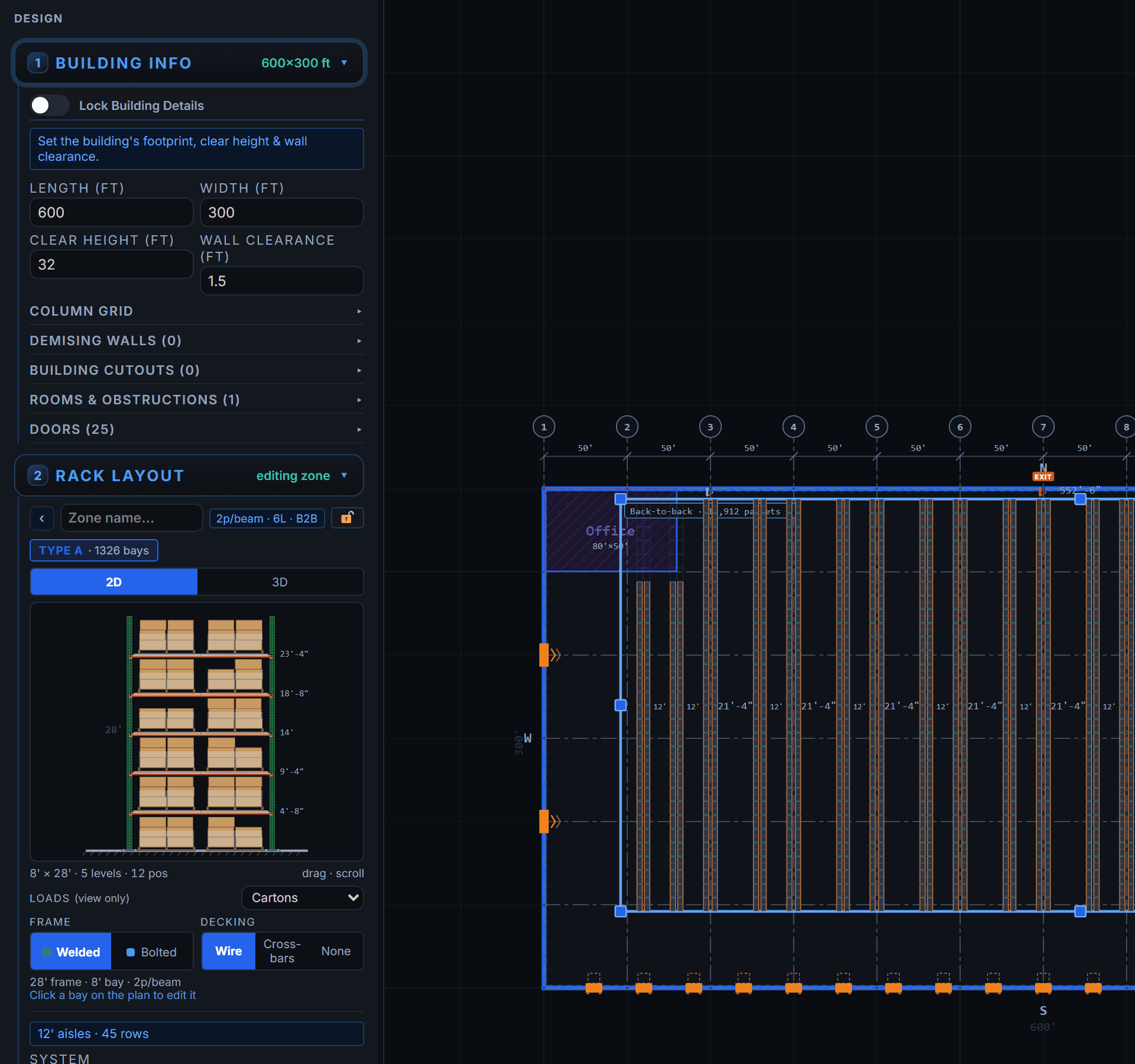
With those, RackCity AI places the rack rows across the building, subtracts the columns, dock doors, staging strip and any office you draw in, and reports the position count per zone and for the whole floor. You can type the numbers in, describe the building to Forky AI in a sentence, or drop the landlord's flyer — a PDF or a photo of the plan — on the page and let it read the dimensions off the plan. Working in metres? Switch Metric mode on and every field, drawing and export follows.
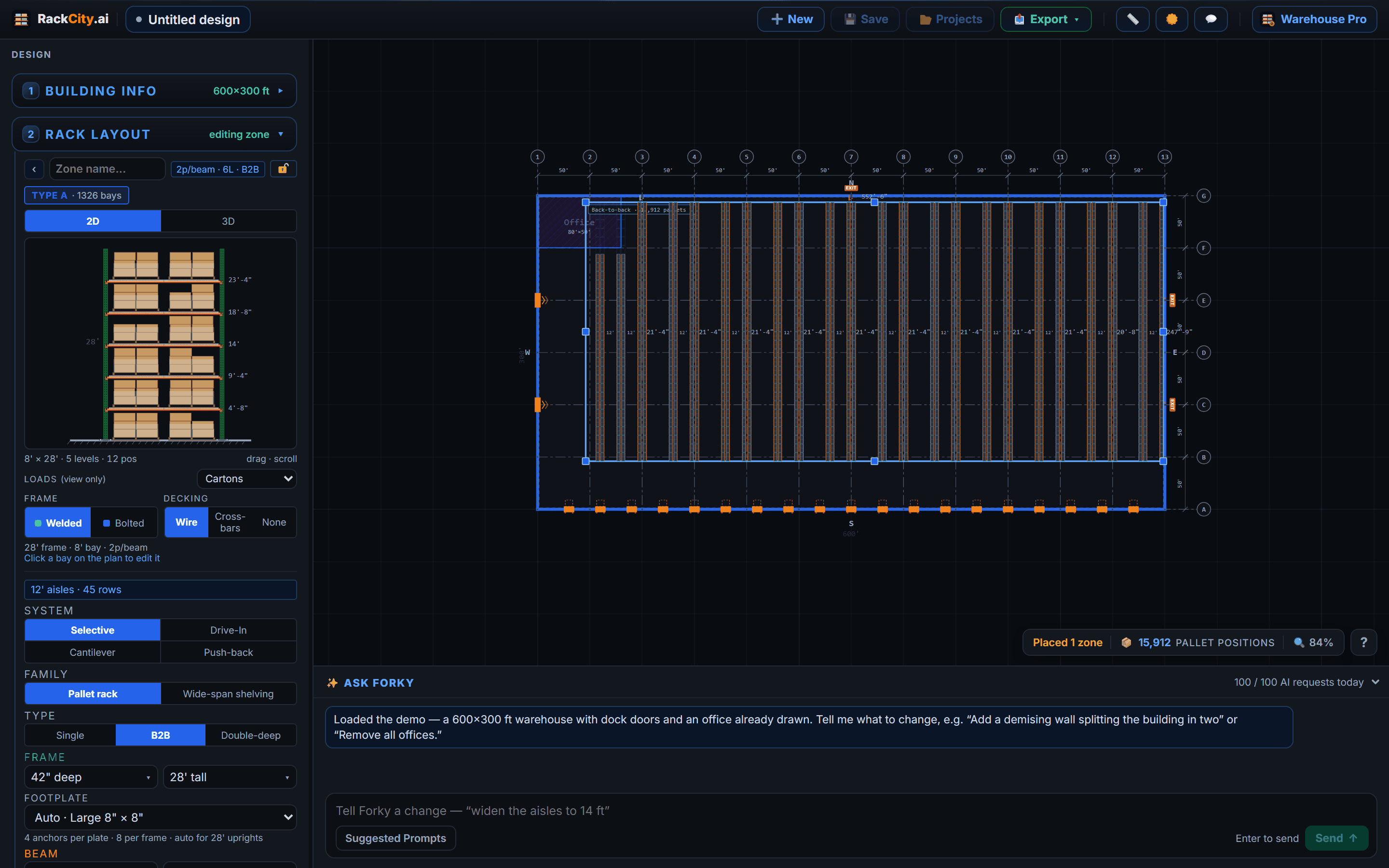
A 200 × 150 ft building (30,000 sq ft) with 26 ft clear, 8 ft back-to-back racks, 48 in pallets, five levels including the floor, 12 ft aisles and a 50 ft dock strip along one long wall comes out near 2,000 positions — about 15 sq ft per position, toward the low end of the range because of the dock strip. Raise the roof to 32 ft clear and a sixth level fits under the sprinklers: about 2,400 positions from the same floor, a 20 % gain for nothing but taller frames.
What Does Pallet Racking Cost?
Installed selective racking in the US in 2026, per pallet position, materials plus labour:
| Configuration | Typical range per position (installed) |
|---|---|
| Standard B2B, 4–5 levels | $80–$120 |
| Heavy-duty B2B, 6+ levels | $110–$160 |
| Double-deep | $130–$180 |
| Very narrow aisle (VNA) | $150–$220 |
Treat these as screening numbers. The real quote moves with upright height and beam capacity, local labour rates, freight from the mill or the used-rack yard, the engineer's stamp and the permit fee, and whether the slab needs core-drilling or repair before anchors go in. Used racking can halve the material line, at the cost of matching frame profiles and a closer look at every beam. For what is inside a cost per position and a fully priced 1,800-position quote, see the pallet racking cost guide.
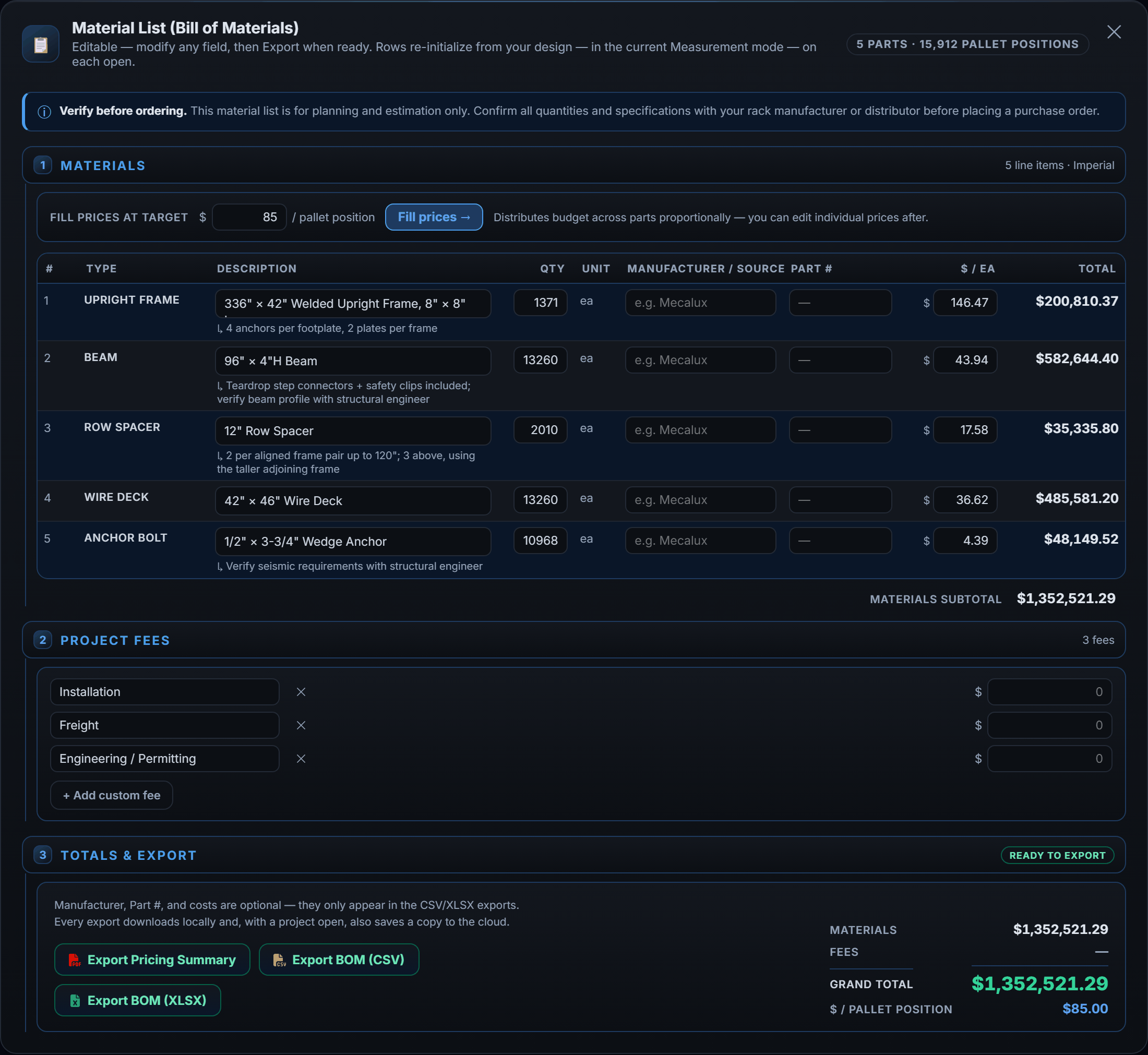
RackCity AI's Bill of Materials is built from the layout, so the frame heights, beam lengths and deck counts are the ones your drawing actually uses. Enter unit prices from a supplier's quote to total it, or use the $ per pallet position fill (it starts at $85) to spread a target budget across the lines and see whether a contractor's number is in the neighbourhood.
What to Do First
Before the contractor visit, spend ten minutes getting your own number:
- Enter the building's dimensions — or upload the landlord's flyer and let RackCity AI read them
- Let the AI draft a layout for your pallet and forklift, or draw the zones yourself
- Read the pallet-position count off the toolbar and open the BOM
You will walk into the conversation knowing roughly how many positions the building holds, how many frames and beams that takes, and what the market charges per position. Contractors price partly on how informed the buyer seems. A layout and a parts list in hand is the difference between "what can you fit in here?" and "I'm expecting about 2,000 positions on 8 ft beams — show me where you differ."
Frequently Asked Questions
How many pallets fit in a 10,000 sq ft warehouse?
Between about 600 and 1,200 pallet positions, and clear height decides which end you land on. A 10,000 sq ft building with 20 ft clear, four beam levels and a dock strip comes out near 600. Add two levels on 28 ft uprights and the same floor holds 900–1,000. A clean rectangle at 32 ft clear with six levels can reach 1,200.
What is the minimum clear height for pallet racking?
About 14–16 ft gets you two beam levels of 48 in loads over a floor position — the least that is worth installing. Plan on at least 22 ft clear for four levels and 26–28 ft for five. Most warehouses built since 2000 clear 28–36 ft. Measure to the lowest obstruction — sprinkler heads, ducts, light fixtures — and leave the flue space the fire code asks for above the top load.
Do I need a permit for pallet racking?
In most US jurisdictions, yes, once the rack is over 5 ft 9 in tall, the height at which the model building code stops exempting racks. From about 8 ft, most cities also want a structural engineer's stamped calculations, and storage over 12 ft high triggers a high-piled storage review by the fire marshal. Your installer usually files the package; allow two to three months from the first submittal to the final sign-off. The elevation drawing from your layout is what the engineer starts from. The pallet rack permit guide has the detail.
How long does it take to install pallet racking?
A crew of three or four installs 600–800 selective positions in two to five days once the steel is on site. Larger jobs scale roughly with the position count; double-deep and VNA take longer per position because of the guidance and the tighter tolerances. The permit lead time, not the crew, is usually what sets the move-in date.
What is a BOM and why do I need one?
A bill of materials is the count of every component the layout needs: upright frames by height and depth, beams by length and capacity, wire decks, row spacers, anchor bolts. A supplier prices it and an installer orders from it. Having your own, generated from a layout of your building, means you can check the contractor's count line by line instead of taking the total on faith.
What forklift do I need for standard pallet racking?
A sit-down counterbalance truck works in 11–14 ft aisles and lifts to roughly 20 ft. A reach truck runs 8–11 ft aisles and lifts to 30 ft or more, which is why most racked warehouses use one. A very-narrow-aisle turret truck works in 5–7 ft aisles but needs wire or rail guidance in the floor. Choose the truck before you finalise the rack: it fixes both the aisle width and the top beam height.
Is there a free pallet rack calculator?
Yes. RackCity AI is free to start: enter the building's dimensions and a rack spec and the pallet-position count updates live as you change beam length, levels and aisle width. The floor plan, elevation and bill of materials come from the same layout, so the count and the parts list always agree.