In this guide
- The short answer
- How often to inspect: three levels
- Green, amber, red: classifying rack damage
- The person responsible for storage equipment safety
- Who can carry out the expert inspection
- In the US: RMI, ANSI MH16.1 and OSHA
- What to do when you find damage
- Column guards and end-of-aisle protection
- Where RackCity AI fits, and where it stops
- Frequently asked questions
The Short Answer
Pallet racking is inspected at three levels: anyone who sees damage reports it at once, a trained person checks it weekly or at an interval set by risk assessment, and a technically competent inspector carries out an expert inspection at least every 12 months. Damage is graded green (record and monitor), amber (repair soon; red after four weeks) or red (offload and isolate immediately), under UK HSE guidance.
Those are the UK numbers, and the US has none of its own in law: the rack standard leaves frequency to the owner, and OSHA enforces through general rules. We build RackCity AI, a layout tool rack sellers and operators use to draw the racking. It does no inspection and no structural calculation, and this guide is an overview, not engineering advice.
How Often to Inspect: Three Levels
The UK Health and Safety Executive's warehousing guide, HSG76, sets out the scheme. In its words, "the inspection follows a hierarchical approach using several levels of inspection" (paragraphs 642 to 646):
| Level | Who | How often |
|---|---|---|
| Immediate reporting | Any employee who sees damage or a safety problem | At once, to the person responsible for rack safety |
| Visual inspection | Trained staff, arranged by the person responsible | Weekly or at other regular intervals based on risk assessment, with a formal written record |
| Expert inspection | A technically competent person | At intervals of not more than 12 months, with a written report and proposed actions |
SEMA, the UK storage equipment manufacturers' association, describes the same three levels in its guide to pallet racking inspections, with the expert inspection "yearly, or twice-yearly … (depending on the risk assessment)".
For automated and high-bay systems, whose upper levels cannot be seen from the floor, HSE asks for an expert inspection every 12 months covering at least 20% of the installation on a rolling basis, so all of it is seen at least every five years.
EN 15635, the European standard on the application and maintenance of storage equipment, codifies the scheme. BSI's catalogue entry says it "addresses the safety and inspection of storage equipment in use, as well as the evaluation of damaged components", and lists the 2008 edition as current and under review. Its inspection clauses are in the paid text, so check your copy or your national guidance before quoting an interval.
In the US, the Rack Manufacturers Institute (RMI) suggests a daily walk through the ends of the aisles, a thorough weekly inspection of the busiest aisles, and a professional inspection at least once a year. Its checklist of recommendations moves from annual to twice a year, quarterly or monthly as risk factors pile up (high traffic, narrow aisles, transfer aisles, prior damage, cold storage), and adds an inspection right after any earthquake or forklift collision.
Green, Amber, Red: Classifying Rack Damage
EN 15635 grades damage to uprights and bracing in three levels. The standard's published contents name them "GREEN LEVEL – requiring surveillance only", "AMBER RISK – hazardous damage requiring action as soon as possible" and "RED RISK – very serious damage requiring immediate action" (clauses 9.5.2 to 9.5.4). HSE's guide uses the same three in its Table 11, Classification of damaged racking, and spells out what each one requires:
| Level | What it means | What you do |
|---|---|---|
| Green | Within the limit that needs no reduction in carrying capacity and no immediate repair. Safe and serviceable. | Record it as fit for service until the next inspection, and mark it for re-examination then. |
| Amber | Severe enough to need remedial work, not severe enough to need immediate offloading. | Repair as soon as possible. Once the load is off a damaged component, do not reload it until it is repaired; isolate the rack, for example with dated labels. Unrepaired after four weeks, it becomes red. |
| Red | A critical level of damage. | Offload that area immediately and isolate it until repaired, usually by replacing the component. HSE's example: the bay is offloaded in the inspector's presence and roped off. |
How much bend in an upright counts as amber or red is a measured limit in the standard itself (clause 9.5.1), which we don't reproduce. An inspector measures it; a driver's eye does not.
The Person Responsible for Storage Equipment Safety
Clause 8.1.1 of EN 15635 says "the user shall appoint a person responsible for storage equipment safety", the PRSES, and that the name should be publicized to warehouse staff. The PRSES identifies and contacts the equipment suppliers, works out the training needed to keep the racking safe, and must know the site's operations and their dangers from a risk assessment.
HSE's 2007 guide calls the same role the "person responsible for racking safety" (PRRS) and gives them the program: setting the inspection frequency, receiving damage reports, ensuring the regular inspections happen and receiving the expert's report. It also asks for a record of inspections, damage and repairs, which can be a logbook. SEMA adds the part that matters most in practice: the PRRS must be able to analyse damage data, spot trends and "have the authority to implement action". A rack safety owner who can't take a bay out of use is a recorder, not a controller.
Who Can Carry Out the Expert Inspection
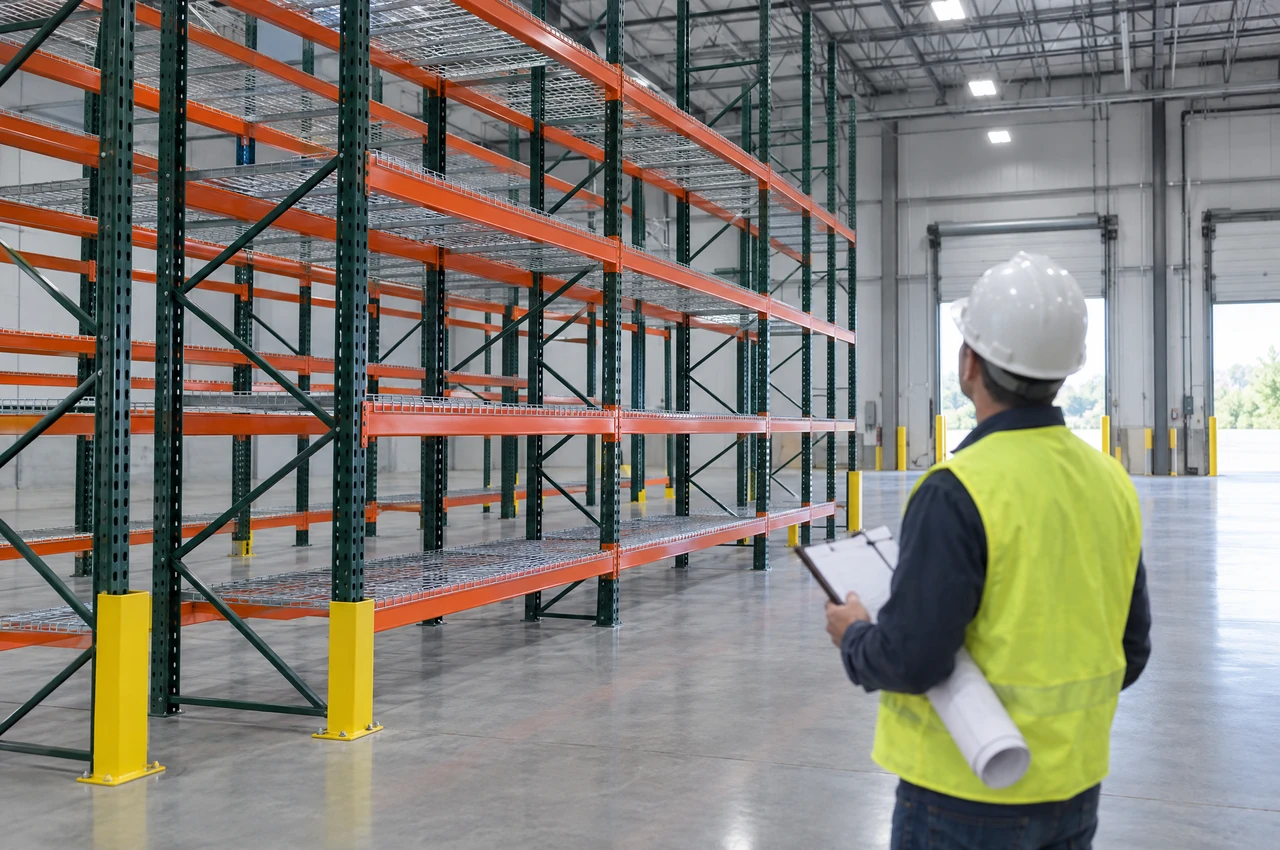
HSE says a technically competent person "might be a trained specialist within an organisation, a specialist from the rack supplier, or an independent qualified rack inspector". Normal inspections are made from ground level unless there are signs of trouble higher up.
In the UK, the recognised qualification is SEMA's SEMA Approved Rack Inspector (SARI): a three-day course, a written exam and a practical assessment, open only to candidates with 2–3 years' experience in rack inspection, risk assessment and report writing. SEMA distinguishes a "damage only" inspection, a list of damaged items and their locations, from a full SARI report.
We found no US equivalent of SARI in RMI's or OSHA's guidance. RMI's advice is to have the rack manufacturer train your staff to spot missing beam connector safety pins as well as dents.
In the US: RMI, ANSI MH16.1 and OSHA
The rack standard. RMI's ANSI MH16.1 puts the duty on the owner. RMI quotes section 1.4.1 of the standard: "Regularly inspect for damage. If damage is found, immediately isolate the affected area." A storage rack design professional then directs the unloading and the repair or replacement needed to restore at least the original design capacity. The standards "do not impose requirements on the frequency of rack inspections"; RMI puts industry practice at monthly to annually.
Plumb. One limit is published: RMI's FAQ gives the maximum out-of-plumb ratio for a loaded rack column as 1/2 in per 10 ft of height (about 4 mm per metre). Columns past it must be unloaded and re-plumbed, and damaged parts repaired or replaced.
OSHA. OSHA has no standard written for storage racks; its warehousing standards page lists general industry rules and names ANSI MH16.1 only among consensus standards that "are NOT OSHA regulations". What applies is 29 CFR 1910.176(b), "Storage of material shall not create a hazard", and the General Duty Clause, which requires a workplace "free from recognized hazards that are causing or are likely to cause death or serious physical harm". OSHA's Region 3 emphasis program for warehousing tells compliance officers to review "the capacity/structural integrity of the racks" and points them to MH16.1 for guidance. So the consensus standard is the yardstick OSHA's own directive points to, even though it is not a regulation.
What to Do When You Find Damage
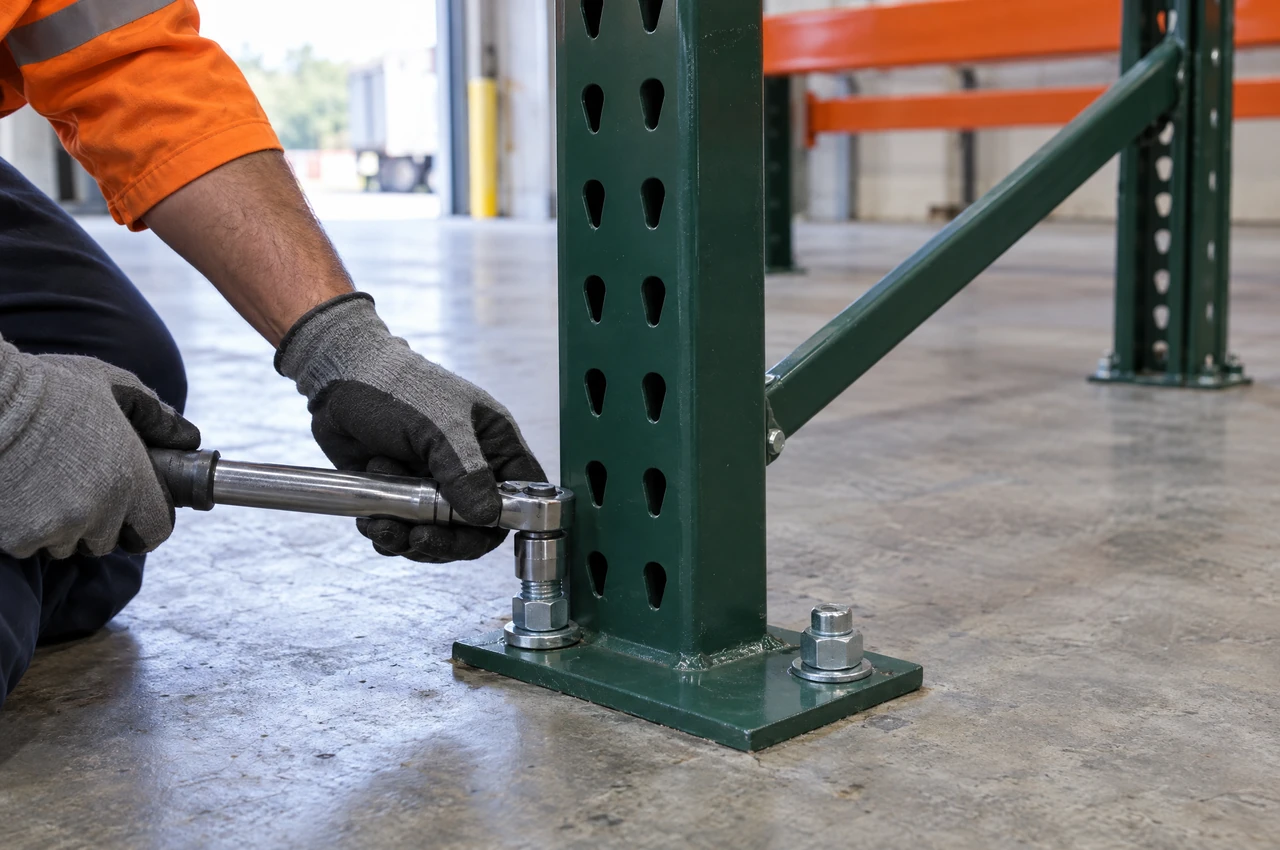
- Report it now. To the PRSES, at once. HSE asks for a system for reporting damage and defects.
- Grade it and stop loading. Red: offload and isolate immediately. Amber: isolate it, don't reload it once unloaded, and repair it before four weeks are up, when it becomes red. Green: record it and recheck at the next inspection.
- Get it assessed. MH16.1 sends it to a storage rack design professional; HSE says to contact the racking manufacturer if there is any doubt about the system's integrity.
- Repair with the right parts. RMI's repair guidance lists four options: an identical part from the original manufacturer, a pre-engineered repair kit, straightening, or a reinforcing field weld, the last three with a qualified rack engineer involved. A part that only looks similar is not a repair: each rack connection is proprietary.
- Log it and look for the pattern. RMI lists prior damage as a reason to inspect an area more often. The same upright hit three times is a layout or aisle problem, not bad luck.
Column Guards and End-of-Aisle Protection
HSE's rule is short: where racking is likely to be struck by lift trucks, protect it. Damage is generally at the lower levels, so use renewable column guards, and give the corner uprights at the end of a run a protective device in a conspicuous colour, because they are especially at risk.
RMI's article on pallet rack column guards names the same two places: the aisle-side face of the columns, and the ends of rack rows, where traffic enters and leaves the aisles, plus cross-aisles and tunnel bays. End-of-row protection is typically a floor-bolted guardrail set a short distance from the rack, or an inverted-U pipe running the rack's full depth. Column inserts, 12 in to 5 ft tall (about 0.3 to 1.5 m), reinforce the upright itself.
Two cautions. RMI says no guard will prevent the rack from failing due to a major collision, and none replaces driver training. And HSE warns that retrofitting guards to an aisle that never had them can reduce truck clearances and, in some cases, increase damage. Guards take aisle width, so the time to plan them is when the aisle width is set, not after the first hit.
Where RackCity AI Fits, and Where It Stops
RackCity AI draws the layout: the rack rows, the aisle widths, the column grid, an elevation for each rack type and a bill of materials, all from the same numbers. Before installation, the aisle width you set decides how much room trucks have and whether guards fit; our aisle width guide gives the bands by truck type. After installation, a dimensioned plan with its elevations records what was meant to be built.
That is where it stops. RackCity AI does no structural calculation, no capacity rating, no inspection and no damage assessment, and nothing it exports is stamped. The person responsible for storage equipment safety, a competent inspector, the rack manufacturer and a rack engineer own those.
Frequently Asked Questions
How often should pallet racking be inspected?
At three levels. Anyone who spots damage reports it straight away, a trained person inspects weekly or at another interval set by risk assessment and keeps a written record, and a technically competent person carries out an expert inspection at least every 12 months. That is the UK HSE's guidance. In the US, RMI recommends an inspection at least once a year, and monthly to twice-yearly checks in busy, narrow or previously damaged areas.
What do green, amber and red mean in a rack inspection?
They are the three damage levels named in EN 15635 and used in the UK HSE's guidance. Green needs surveillance only: the component stays in service and is re-examined at the next inspection. Amber is hazardous damage that needs repair as soon as possible: once its load is off, it stays off until the repair is done, and HSE says it becomes red after four weeks unrepaired. Red is very serious damage: offload that area at once and isolate it until it is repaired.
Who is allowed to inspect pallet racking?
The routine checks are usually done by trained staff on site, reporting to the person responsible for storage equipment safety. The expert inspection needs a technically competent person, which HSE says can be a trained specialist within the company, a specialist from the rack supplier or an independent qualified rack inspector. In the UK, SEMA trains and qualifies expert inspectors under its SEMA Approved Rack Inspector (SARI) scheme.
Does OSHA require pallet rack inspections?
OSHA has no standard written for storage racks. It applies 29 CFR 1910.176(b), which says storage of material shall not create a hazard, and the General Duty Clause, which requires a workplace free from recognized hazards likely to cause death or serious physical harm. ANSI MH16.1, the RMI rack standard, tells owners to inspect regularly for damage; OSHA lists it as a consensus standard, not a regulation.
Can damaged pallet racking be repaired instead of replaced?
Sometimes. ANSI MH16.1 has a storage rack design professional evaluate the damage first. RMI's guide then lists four options: an identical replacement part from the original manufacturer, a pre-engineered repair kit, straightening the component, or reinforcing it with a field weld, the last three with a qualified rack engineer involved. Never fit a part that only looks similar: rack connections are proprietary, and a different steel thickness changes what the rack can carry.
Does RackCity AI inspect racking or check its capacity?
No. RackCity AI draws the layout: rack rows, aisle widths, the column grid, an elevation for each rack type and a bill of materials. It does no structural calculation, no capacity rating and no inspection, and nothing it exports is stamped. Damage assessment and repairs belong to a competent inspector, the rack manufacturer and a rack engineer.
UK: the Health and Safety Executive's HSG76, Warehousing and storage: a guide to health and safety (second edition, 2007), paragraphs 639 to 653 and Table 11; SEMA's guide to pallet racking inspections and SARI course page. Standard: BSI's BS EN 15635:2008 entry and the published preview of EN 15635:2008 (the Slovenian adoption, SIST EN 15635:2009) for clause 8.1.1 and the damage-level clause titles. US: the Rack Manufacturers Institute on inspection requirements, inspection frequency, daily and weekly checks, repair or replacement, column guards, impact protection and out-of-plumb limits. OSHA: 29 CFR 1910.176, OSH Act section 5, the warehousing standards page and directive CPL 2022-01. Read the current edition your country or customer works to; this page is an overview, not engineering advice.