The One Question That Picks the System
Every rack system trades selectivity (can a truck reach any pallet without moving another?) for density (how many pallets fit in the floor area?). Selective rack sits at one end: every position faces an aisle, so selectivity is 100 percent and the aisles eat about half the floor. Drive-in sits at the other: lanes ten pallets deep with one aisle for the lot, so most of the floor is storage and most of the pallets are behind another pallet.
Where your inventory falls on that line is a question about pallets per SKU. A SKU with two pallets in stock has no business in a five-deep lane — the lane is 60 percent empty from the day it is loaded, which vendors call honeycombing. A SKU with forty pallets in stock is wasting aisle on selective rack. The dealers' rules of thumb are consistent: push-back earns its keep when a SKU holds more than about five pallets, and a lane should hold roughly four to five times its depth in pallets of one SKU. The second question is access order: drive-in and push-back are last-in-first-out by construction; selective is any order; pallet flow and carton flow are first-in-first-out.
Selective Pallet Rack
The baseline: upright frames and pairs of beams, one pallet deep from the aisle, every position reachable. It comes in three row types. A single row stands against a wall; a back-to-back pair shares a flue between two aisles and is how the interior of almost every warehouse is racked; double-deep puts two pallets behind each face and needs a reach truck with a double-deep attachment, buying more positions per aisle at the cost of half the faces.
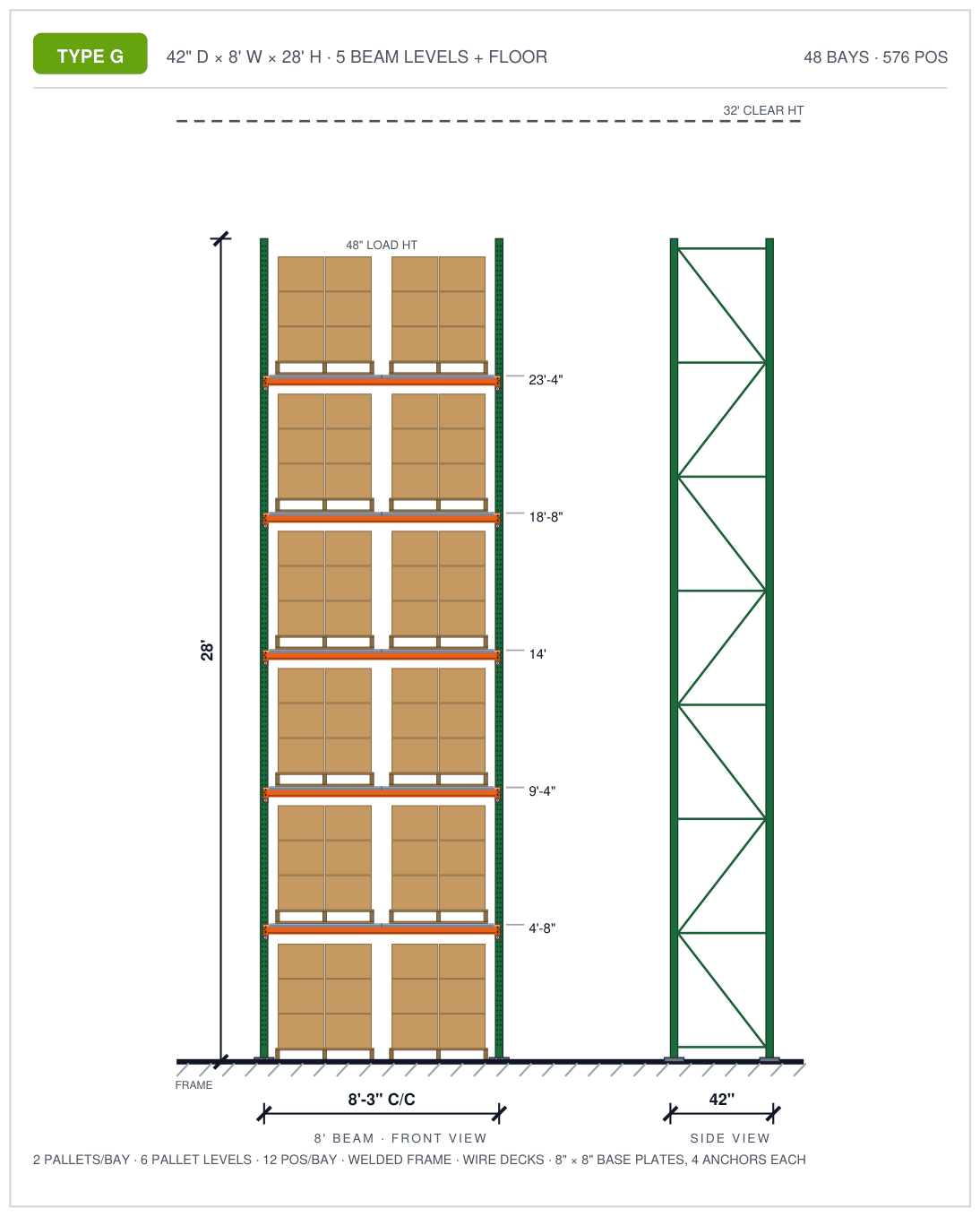
Use it for the long tail — many SKUs, few pallets each, mixed pallet heights, anything picked by the case from the lower levels. What it costs: the cheapest system per position, around $80–$160 installed in 2026, and the cheapest to change later. What it gives up: floor. Aisles for a counterbalance truck run 11–14 ft, a reach truck 8–11 ft, and a very-narrow-aisle turret truck gets under 7 ft, which is the usual way to make selective denser without changing the system.
Drive-In Rack
Lanes one pallet wide and two to ten pallets deep (dealers quote up to twelve), with the pallets resting on rails down each side of the lane and the forklift driving into the rack to set the rearmost pallet first. One aisle serves the block; every lane is one SKU; access is strictly last-in-first-out. Drive-through is the same structure worked from both ends, which makes FIFO possible at the price of a second aisle.
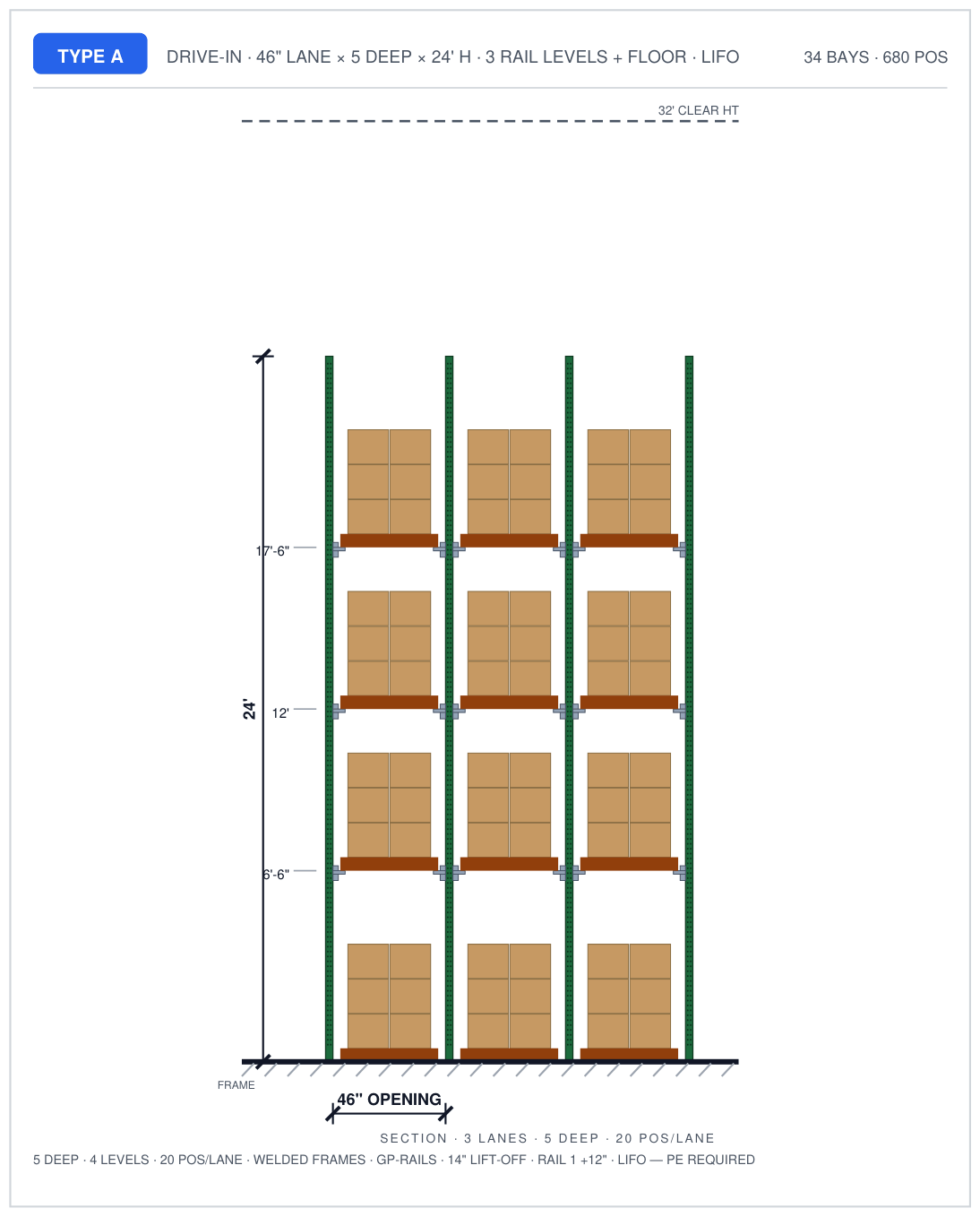
Density: the densest of the systems on this page — vendors quote about 75 percent more pallets than selective in the same floor area, and it is the lowest cost per position of the dense types, typically $150–$250 installed. What it costs you elsewhere: the truck enters the rack, so drive-in takes more abuse than any other system and the lane openings, rail heights and truck clearances are engineered, not picked from a catalog. Honeycombing is real: one dealer's figure is 40 percent of positions empty on average, against about 85 percent occupancy on flow rail. Lane depth follows the pallet — each pallet plus about two inches of clearance, plus a few inches at the front — and the storage-level height is the load height plus eight to twelve inches depending on the rail type.
Use it for a handful of SKUs held in real volume — cold storage and freezers above all, where every square foot of the room costs to cool, and beverage, produce or seasonal build-ups where the whole lane turns together.
Push-Back Rack
A pair of deep frames, two to five pallets deep on nested carts (or roller channels, which the vendors push past four deep), loaded and unloaded from one aisle. Setting a pallet pushes the ones behind it up a slight incline — about three-eighths of an inch per foot — and taking one lets the rest roll forward. The truck never enters the rack, every lane is reachable from the aisle, and the frames are often built back-to-back so two aisles serve one block.
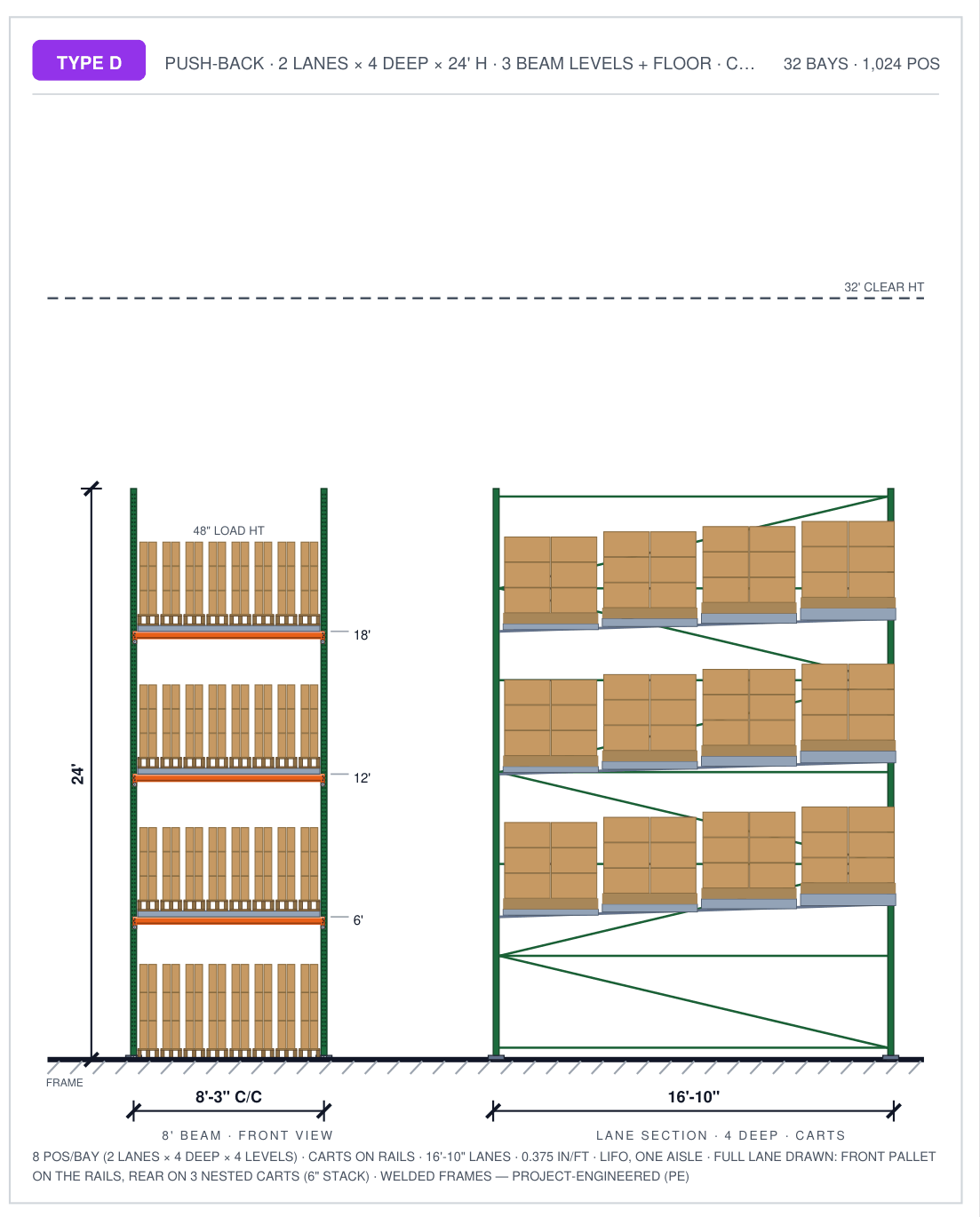
Density and selectivity: vendors quote up to 90 percent more storage than selective and several times the selectivity of drive-in, because a lane is a SKU, not a block. Lane depth is fixed by the pallet — for 48-inch pallets the manufacturers' frames run 102 / 152 / 202 / 252 in for two to five deep — and the cart stack adds five to seven inches to each level, so a four-deep bay needs about a foot more per level than selective. What it costs: more per position than drive-in, well under pallet flow; the carts are the price. Use it for the SKUs with more than about five pallets on hand that still need to be reachable in any order — the middle of the ABC curve, and the reason most mixed buildings end up with a push-back block beside the selective rows.
Cantilever Rack
Columns on bases with arms cantilevered off one side (against a wall) or both (in the interior), and no front upright in the way — so a 12-foot or 20-foot load rests across several arms. It is the system for lumber, pipe, bar stock, sheet, furniture and rolls, and the wrong one for pallets. Rows are laid out the way large yards are: double-sided rows through the interior with a single-sided row along each wall, every row facing a forklift aisle.
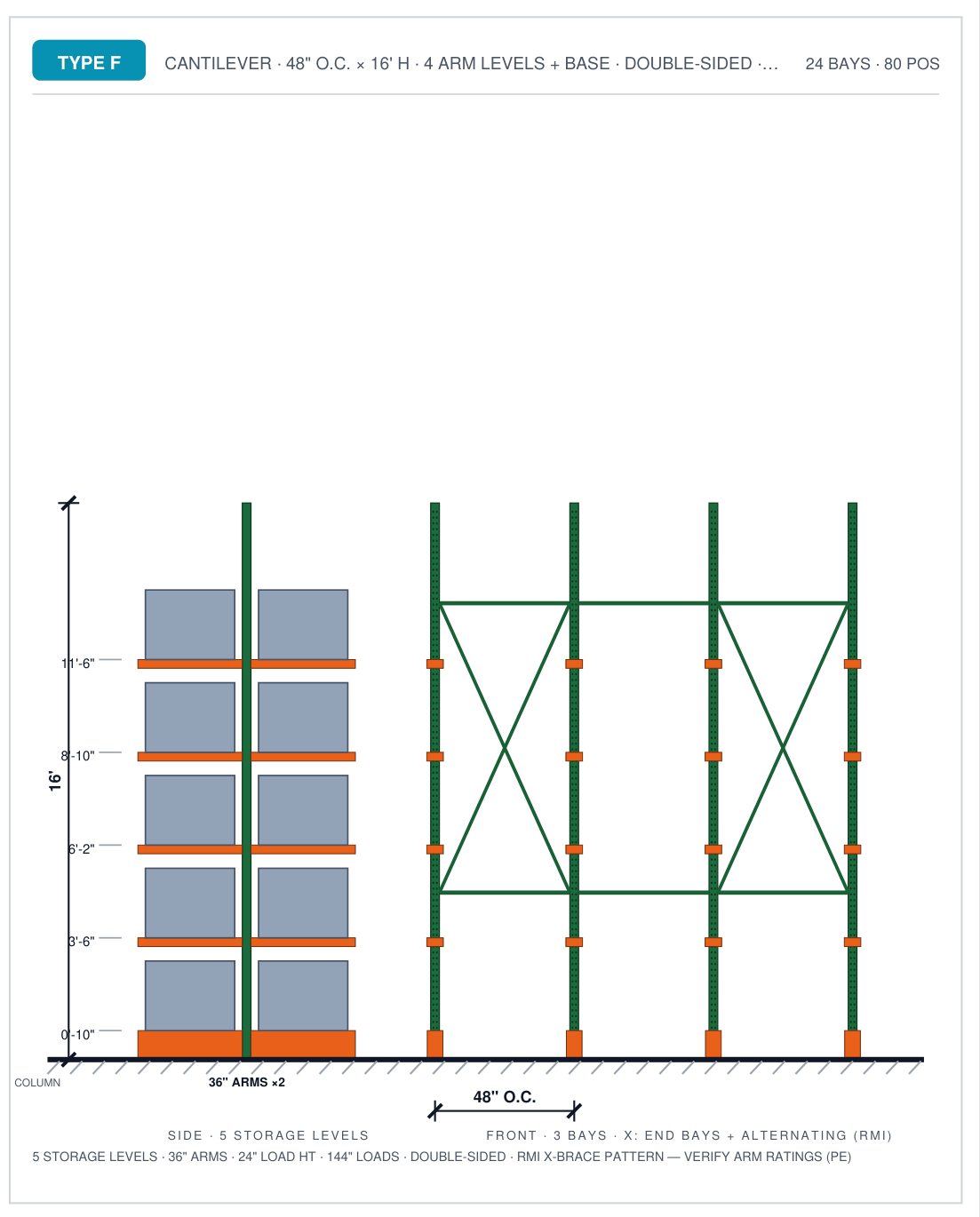
The rules that size it: arms come in 12 to 72 inches in 6-inch steps and must equal or exceed the load depth; columns sit no farther apart than half the load length so a load always rests on at least two arms; the column extends above the top arm by at least the base height; the base is as long as the arm; two anchors per base. Vendors' arm ratings run from a few hundred pounds to several thousand, and an off-centre load cuts the rating by half. Density is not the point — access to a long load is. RackCity counts cantilever in load positions, kept apart from pallet positions in every total, and warns when the columns sit farther apart than half the load.
Carton Flow and Hand-Pick Levels
Not a pallet system but the one that shares a building with all of them. Carton flow is a roller or wheel bed running through a back-to-back pair of rack, loaded from the back aisle and picked from the front, sloped about an inch per foot so the next carton rolls to the pick face — first-in-first-out by construction. Lanes come in 6 to 24 inch widths; the bed fills the bay and pallet storage carries on above it. Hand-pick levels are the simpler cousin: the bottom levels of a selective bay decked edge to edge as static shelves, with pallets above.
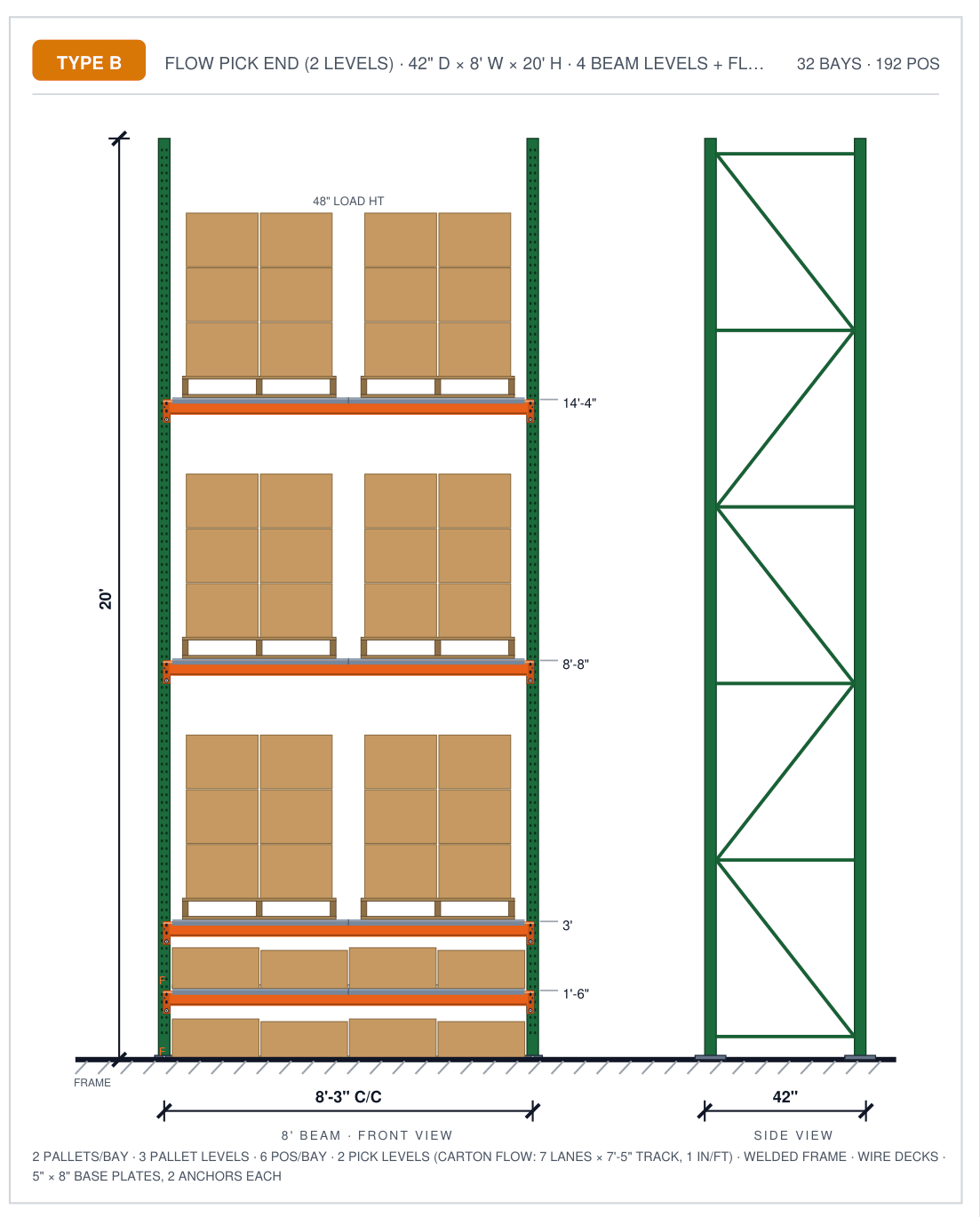
Use it for the case-pick SKUs — vendors quote several times more SKUs per bay than pallet positions and picker travel cut by most of a shift. Watch the two heights that matter to the people working it: the top pick surface against a 60-inch reach, and the first pallet beam against the 84 inches a shared forklift aisle wants.
Wide-Span Shelving
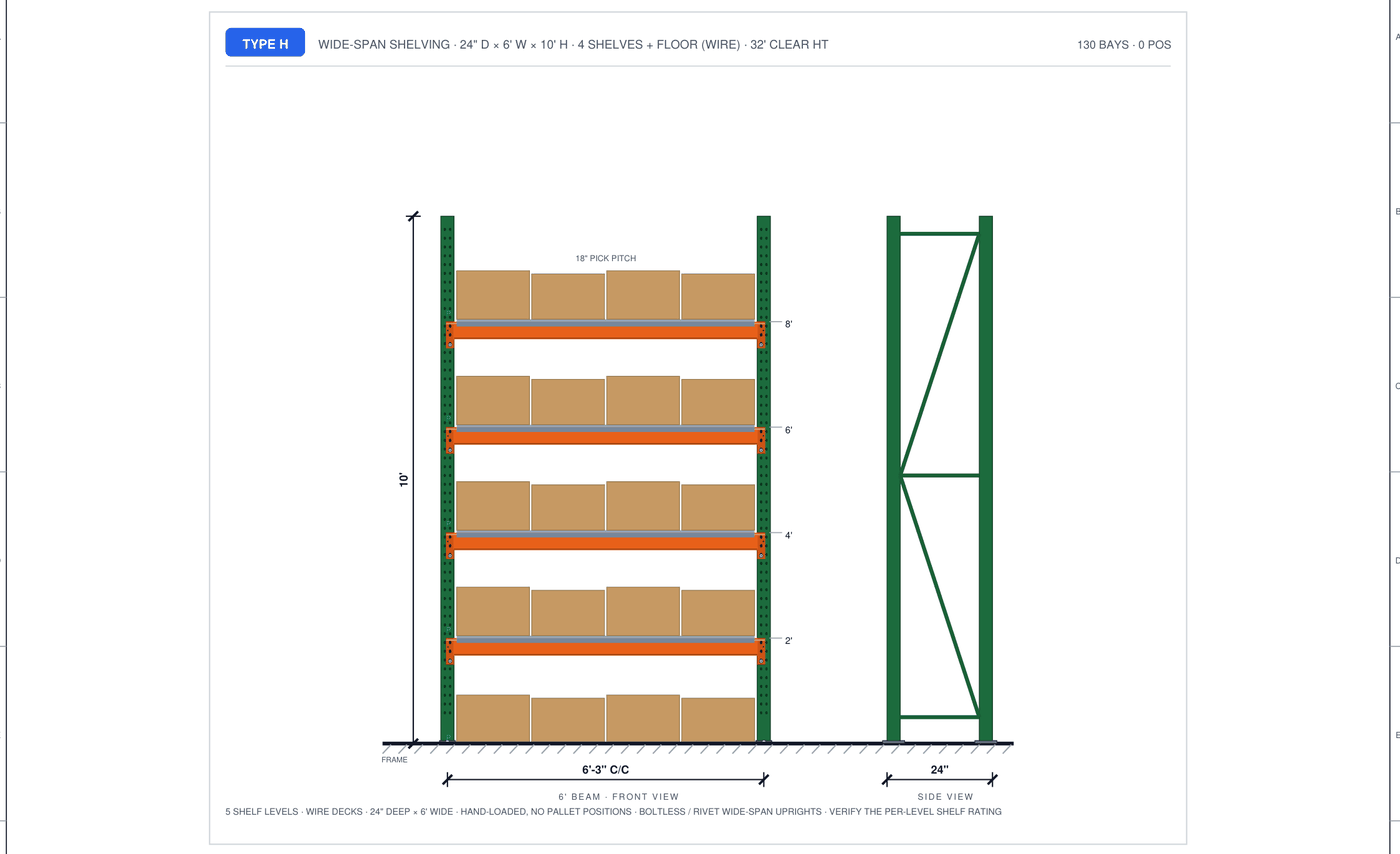
Hand-loaded bulk shelving on rack-style frames — the step between pallet rack and library shelving, for case and piece picking accessed on foot. Beams run 4 to 8 ft (some lines to 12), depths 18 to 48 inches, heights to 20 ft, and shelves adjust on 2-inch centres. Every level is a decked shelf; the aisles are people aisles, not truck aisles, which is what makes it dense for what it holds.
The Comparison Table
| System | Access order | Depth | Density vs selective | Selectivity | Best for |
|---|---|---|---|---|---|
| Selective (single / back-to-back) | Any | 1 pallet | 1× (the baseline) | 100 % | Many SKUs, few pallets each; mixed heights; case-pick below |
| Double-deep | LIFO per pair | 2 pallets | More positions per aisle | Half the faces | SKUs held 2+ pallets, with a double-deep reach truck |
| Drive-in | LIFO (drive-through: FIFO) | 2–10+ pallets | ~75 % more | Lowest — one SKU a lane, truck in the rack | Cold storage; few SKUs in volume; seasonal build-ups |
| Push-back | LIFO | 2–5 pallets (carts), to 6 on rollers | Up to ~90 % more | Every lane from the aisle | The middle of the ABC curve: 5+ pallets a SKU, any order |
| Pallet flow (not yet in RackCity) | FIFO | 2–20 pallets | Up to ~100 % more | Every lane, from a separate pick aisle | Date-sensitive stock at 15+ moves a SKU a day |
| Cantilever | Any | Arm length 12–72 in | Not the point | 100 % | Lumber, pipe, bar, sheet, rolls — anything long |
| Carton flow | FIFO (cartons) | Through the pair | Several × the SKUs per bay | Every lane at the pick face | Case-pick SKUs under pallet storage |
| Wide-span shelving | Any | 18–48 in shelf | Counted in pick faces | 100 % | Hand-loaded bulk, piece and case picking on foot |
The density figures are the manufacturers' and dealers' own comparisons and vary with lane depth, pallet size and how full the lanes actually run; treat them as the order of magnitude, not a promise. One integrator's worked example for a 40,000 sq ft floor at five deep is the useful scale: about 4,000 drive-in positions, 4,550 push-back, 3,600 pallet flow — the second aisle is what pallet flow pays for FIFO with.
Mixing Systems in One Building
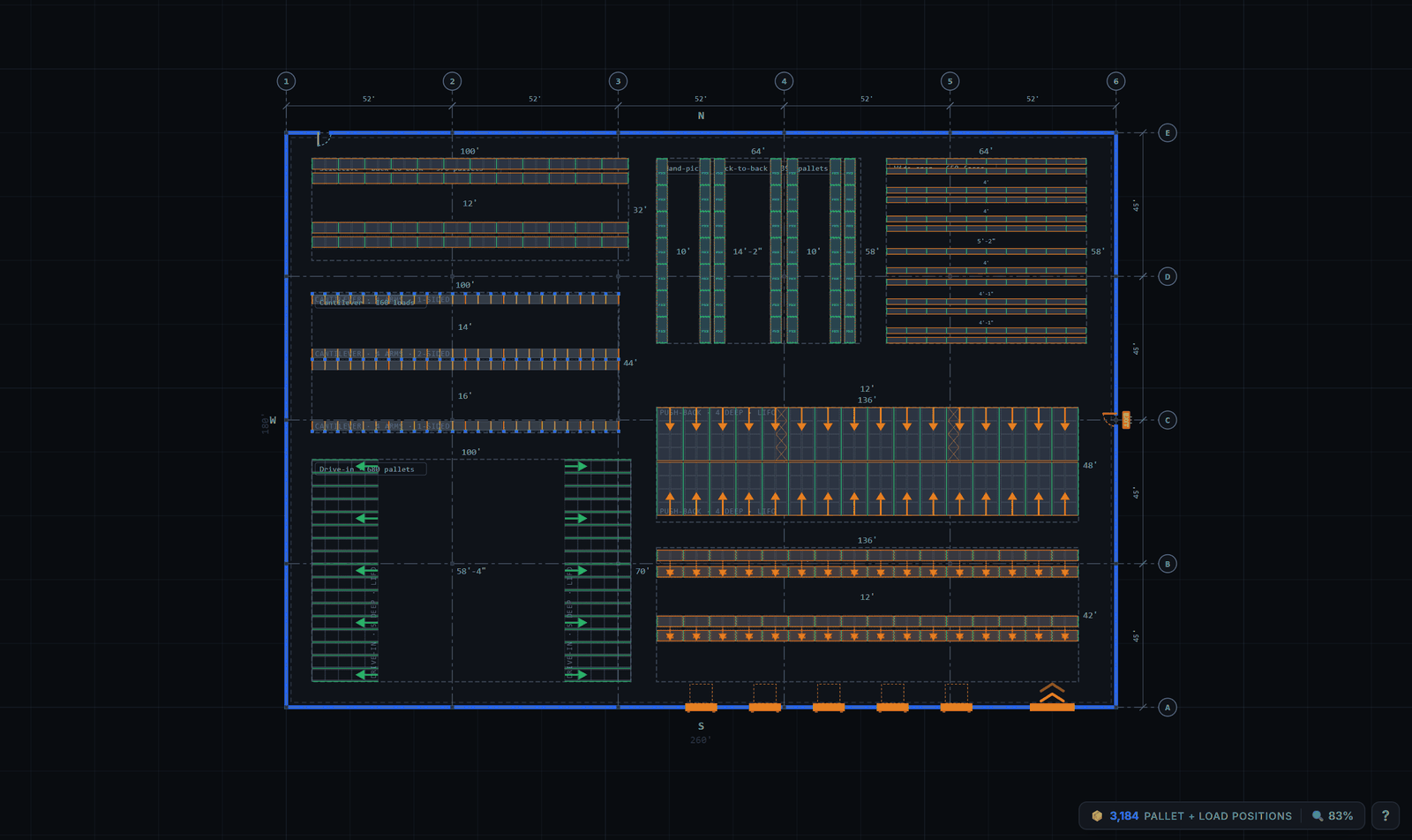
The comparison above is rarely a choice of one. A distribution centre's inventory has a shape — a few SKUs with dozens of pallets, a middle band with a handful each, and a long tail of one or two — and the racking follows it: drive-in or push-back for the head, selective for the tail, carton flow or hand-pick levels on the bottom of the selective rows for whatever is picked by the case, and a cantilever row along a wall for anything that does not fit on a pallet. Cold rooms lean toward drive-in; e-commerce toward carton flow under selective; building-products distribution toward cantilever with a selective block beside it.
What makes the mix hard to plan on paper is that each system has its own arithmetic — lane depths, cart stacks, arm spacing, shelf pitch — and a change to one zone moves the totals of the whole floor. That is the job RackCity was built for: a zone per system in one building, each packed by its own engine from the vendors' numbers, with the pallet, load and pick-face counts on separate totals, one elevation per rack type on the drawing set, and a material list that bills carts, rails, arms and track alongside the frames and beams. When a lane does not fit, the zone panel says which bay and by how much, instead of drawing it anyway.
Frequently Asked Questions
What is the difference between drive-in and push-back racking?
Both are LIFO systems loaded from one aisle. In drive-in the forklift drives into the rack on rails, one SKU per lane, typically two to ten pallets deep — the densest and cheapest per position but the slowest to work and the hardest on the rack. In push-back the pallets ride nested carts on inclined rails, two to five deep, so the truck never enters the rack: every lane is reachable from the aisle, which is why vendors quote far more selectivity than drive-in at a similar density.
Which pallet rack type gives the most pallets per square foot?
Of the systems RackCity draws, drive-in stores the most per square foot — vendors quote about 75 percent more pallets than selective in the same floor space — with push-back close behind at up to 90 percent more but with every lane reachable from the aisle. Pallet flow (FIFO gravity lanes) is denser still but the costliest per position. Selective rack is the least dense and the only one with 100 percent selectivity.
When should I use cantilever rack instead of pallet rack?
When the load is long rather than palletised — lumber, pipe, bar stock, sheet, furniture, rolls. Cantilever has no front upright in the way, so a 12 ft or 20 ft load rests on arms cantilevered off columns spaced no farther apart than half the load length. It is the wrong tool for pallets: a pallet on arms is what one vendor calls cutting a cake with an axe.
Can I mix rack types in one warehouse?
Almost every real warehouse does. The usual split is selective for the long tail of SKUs, push-back or drive-in for the few SKUs held in volume, carton flow or hand-pick levels on the bottom of the selective rows for the case-pick items, and a cantilever row along a wall for anything long. RackCity lays out a zone per system in one building and keeps the pallet, load and pick-face counts on separate totals.
Is FIFO possible without pallet flow?
For pallets, real first-in-first-out needs a system with a load aisle and a separate pick aisle: pallet flow, or drive-through (a drive-in worked from both ends). Selective rack gives FIFO by discipline — every position is reachable, so the warehouse management system can call the oldest pallet. Drive-in and push-back are last-in-first-out by construction. For cartons, carton flow is FIFO: loaded from the back aisle, picked from the front.